Flux & Flow

21 June Sunrise

I love the weather!

What started as a sultry morning with still seas, has in less than 30 minutes, turned into a blustery morning. Soft winds, first from the west – unusual – clocked to the south, rounded to the east, turned to the north, and swung back to pour in from the south. Local weather station, El Jaral, shows a steady 20.9 KM .. White caps before 7:30 AM!

Except for the warm temperatures and the wind direction, more like a February morning … 30% chance of showers tomorrow!

So…. not a SUP morning, and decidedly not a good swimming, snorkeling, or fishing morning .. and even the beach walkers are hunkered down.

Life, like the weather : flux & flow.

Morning Count …

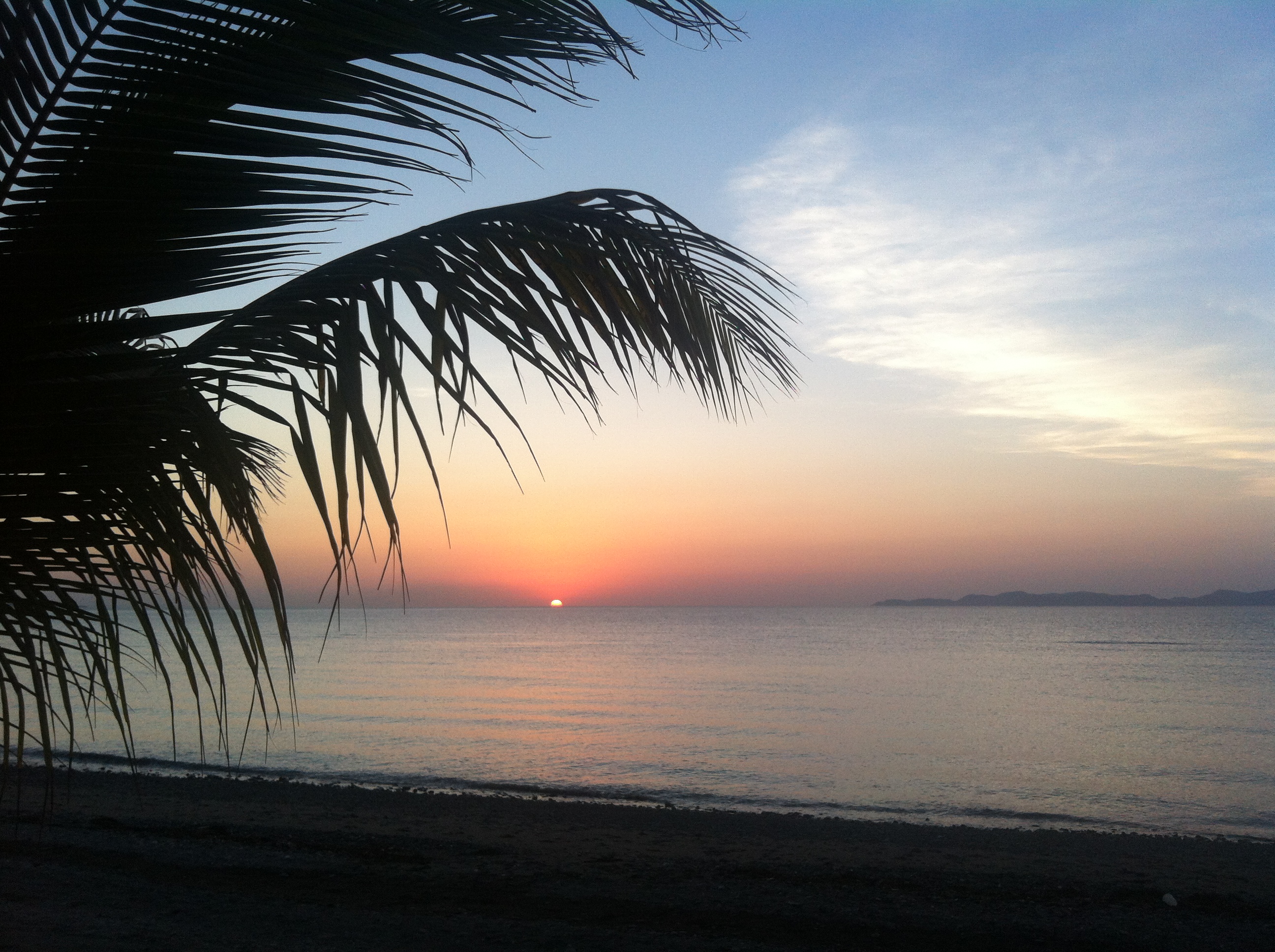
Sunrise : Sea of Cortez

Glassy seas. Sultry temps. SUP morning.

Heron studies baby fish from his long-legged perch, while the osprey hovers mid-air before diving to grasp a tiny sardine in his talons.

Overhead, Magnificent frigate bird chases down a gull that has stolen its fish.

An ‘army’ of baby puffer fish gathers together in the shallows near a point to the north, and beyond them, baby stingrays – round, cortez, and bullseye. It feels as if I’m paddling through a nursery.
A trumpet fish, then a coronet. Tiny yellowtail.

Pelicans glide inches above the water, splitting their formation to pass on both sides of me.

On my return, the morning’s gift : A giant sea turtle, his back covered with barnacles, escorts me as I paddle home.

Dad’s Day

Crofton Myles Cooper : My Dad

in the quiet this morning, i embrace listening …

last night i sat under the stars : listening …

my own voice replaced by …. the flap of wings…  the toss of stones… the slap of sea… the hum of foraging bees… the coo of dove… the chatter of fishermen…  my neighbor on her phone… church bells ringin in town. pelican splash… hummingbird whir … oriole chatter …

the palms in bloom. their feathery tendrils reach down and cast thousands of tiny black seeds .. all hoping to be born into big trees

dads day.

the empty space that once he filled .. i hear his voice, gravely, “let me tell ya kid …”

i see the twinkle in his blue eyes, feel his hand grasping mine .. the first steps .. the last steps …

Cabo Pulmo Saved!

Mexican President Calderón withdraws permit for development of Cabo Cortez

by Catharine Cooper, for The Ocean Foundation

A massive school of stingrays at Cabo Pulmo (Photo: Fleur Schultz)

In an unprecedented move, Mexican President Felipe Calderón withdrew the development permit for the 9,400 acre development of Cabo Cortez on the southern tip of Baja California. The land, adjacent to Cabo Pulmo National Marine Reserve, had become a regional – if not national cause – among ocean conservationists and environmentalists because of its proximity to the only intact coral reef in the Sea of Cortez.

The reef itself is estimated to be 20,000 years old and is home to 226 of the 875 species that exist in the region. Cabo Pulmo National Marine Park was created in 1995 and encompasses 17,750 marine acres. Parts of the shallow coral mountain lie just 10 miles offshore. In addition to sea turtles, dolphin, tiger and bull sharks, migrating blue and humpback whales, and rare whale sharks congregate in the area. (For a stunning collection of Cabo Pulmo photographs, see National Geographic’s Pictures: Best Marine Park? Booming Fish Leap and Swarm)

Decades of overfishing and the commercial practice of dragging anchors and nets had left the reef nearly devoid of life. In the early 90s, local fishermen recognized the need for protection, and rallied for the reserve. Four years after its establishment, monitors from Autonomous University of Baja California Sur (UABCS) and Scripps were astonished at the changes in the sea life. Enforcement of the no fishing/no take zone had given rise to Gulf groupers larger than anywhere else in the Gulf, dense schools of predatory jacks, increased numbers of black top reef sharks, and other predators.

In 2005, Cabo Pulmo was designated a UNESCO World Heritage Site, and in 2008 it was added to the Ramsar List of Wetlands of International Importance. A great deal of credit goes to the local population, who made a dramatic shift from fishing to eco-tourism, and put their muscle to enforcing the marine protections. A study released by Scripps Institute of Oceanography reported that in August 2011, Cabo Pulmo’s biomass – the total weight of living species – had increased by 463 percent from 1999 to 2009. “No other marine reserve in the world has shown such a fish recovery,” wrote researcher, Octavio Aburto-Oropeza.

Such great results made the Mexican government’s permit of the upscale/uber-development Cabo Cortez all the more mind-boggling. For a local population to have worked so hard to bring life back to the sea, and to be sanctioned and honored by numerous world-wide organizations, it seemed impossible to believe that a permit for 9,380 acres with seven hotels, 27,000 guestrooms, two golf courses, a marina for 490 boats, and 5,000 residents for workers could even be considered.

Groups such as U.S. NGO Wildcoast, the Mexican NGO Niparajá, Pro Natura Northwest, Community & Diversity, Friends of Cabo Pulmo, Scripps Institute of Oceanography, the World Wildlife Fund, Greenpeace, and UABCS joined together to protest Cabo Cortez. Their efforts proved that grassroots campaigns could be effective.

An onslaught of media outlets – websites, newspapers, radio spots, and prime time television segments – garnered attention. A photo exhibition was staged in the Federal Senate and Legislative Palace in Mexico City to highlight the importance of the Reef, and led to motions against the proposed project. Pressure was placed on Mexico’s environmental protection agency to revoke the development permit.

In his announcement on Friday the 15th of June 2012, Calderón restated environmentalist concerns. “Because of its size,” he said, “we have to be absolutely certain that it wouldn’t cause irreversible damage, and that absolute certainty has not been proved.”
Omar Vidal, the head of WWF Mexico, called the announcement, “an important victory, because it shows that when the public organizes, it can achieve great things.”

For the moment, we who care most deeply have spoken for the sea, and we have been heard. The fragile resuscitated reef is safe – temporarily. The chemical run-offs, garbage and waste water, which would have resulted form the enormity of development – and killed off reef life once again – has been halted. However, the owners of the land, a Spanish development group, Hansa Baja Investments, stated in a press conference, that they would re-apply, and would take counsel from qualified advisors. Their new plan will be, “… compatible with the conservation and preservation of the area’s environment.”

Residents of the area would prefer no development at all. With their shift from fishing to scuba tours, kayaking trips and other eco-based activities, the community is working to develop their own model for sustainable tourism in southern Baja. Integral to the program is to maintain the rustic environmentally friendly atmosphere of the community, and to expand that vision to other towns in the region.

In other words, there is no need for another Cabo or Cancún. We need more places that are safe to swim, to snorkel, and be in the sea. We need seas that are healthy, free of pollutants and teaming with life. Our underwater friends and partners depend on us to make that happen. So join hands with The Ocean Foundation, and put your heart and spirit into protecting the seas.

http://news.nationalgeographic.com/news/2011/08/pictures/110815-worlds-most-robust-marine-park-cabo-pulmo-science-mexico-baja-california-public/
Island Living

Loreto is surrounded by seven islands, which lend themselves to abundant snorkeling, diving, fishing, whale/dolphin/manta watching, sailing, SUP. and beaching opportunities. It’s a water paradise with sea temps in the 80s in July, August and September.

The peninsula itself is a long finger of land surrounded wrapped by the Sea of Cortez on the east coast and the Pacific on the west. A day’s drive and a traveler can experience two vastly different environmental climates. The middle of the Baja can be more like an inferno mid-summer, with temps not unusual in the 110+ range.

“On the Island”

It is the sea that draws me, holds me, keeps me waking next to water and all her power to soothe, to invigorate and to heal. My new neighbor, Dave, took this photo this morning of my Casa de Catalina using an iPhone ap : http://www.photosynth.net.

It certainly appears from this image that I live on an island. What a whoop! Better get the paddles out!

Hot Sultry Mornings

Dawn, Sea of Cortez

Dawn : Day 140 : Sea of Cortez

It’s hot. Spring has flashed to summer with the turn of a switch.

Dawn comes with still seas and air that carries the heavy scent of salted water.

From my writing perch, I watch orioles dash palm to palm, nipping at dried fronds for nesting materials. Small hummingbirds lap at red flowers, doves coo from the neighbor’s rooftop, and house wrens flitter between plantings and small trees.

A wondrous way to wake ….

Beach walkers – with and without dogs, ply the beach. A few youngsters hurry past on their morning run. Buster begs me to stop writing and take him on an adventure.

In the distance, the tinkle of the bottled water delivery man’s truck. It reminds me of the bells on the ice cream man’s truck when I was a small child in Long Beach, CA.

Behind the sweet tinkle is the loudspeaker of the day’s political broadcastings. A sedan of undetermined color circles the hood, a speaker mounted to the roof of his car, with a taped recording blaring into the otherwise quiet space. While my Spanish isn’t perfect, there is something about the tinniness and the volume of the speaker that renders the advertisement unintelligible. I grasp it’s for one or other of the candidates vying for votes in this year’s election.

Quiet already disturbed, trucks laden with soil to fill a neighborhood lot arrive, followed by a large bulldozer that begins to spread the earth.

Time for another cup of coffee – and put the day in order.

Only in Mexico

Only in Mexico could the transport of a huge tank that utilizes the entire width of Mex 1 – the solitary two-lane highway that spans the peninsula – take place in the full light of day. No matter that traffic backs up for hours over the spiny mountain climb through the central deserts of Baja. No. Just a couple of guys riding on the very back (no seat belts or other security measures) waving traffic to ‘back off.’

At special spots on ridges with a small pullout, the caravan (three huge trucks all tied together – imagine a Burlington-Santa Fe train – pulling this enormous tank) would simply stop. Rather than the rigs pulling over, the dudes on the back jump down and begin to direct north and south bound traffic around the road covering vehicles.

In between the stops, the traffic sooooo slow (around 8 MPH) let travelers kind of hang out, chat while ‘parked’ in the middle of the road.

In the States, it would require mountainous piles of permits, special hours of travel, police escorts with sirens and flashing lights, a special traffic co-ordinator, and specified rest stops.

It’s scenes like this that really bring travel Mexico to my heart. All that’s required is patience and a good sense of humor – along with a dollap of curiosity.

The tank? Probably bound for Santa Rosalia and the newly re-established copper mines.