The Track of Hurricane Odile

Horricane Odile's Track up  the Spine of Baja

Horricane Odile’s Track up the Spine of Baja

I am a storm watcher/lover .. but this one, Odile, may be hard to love. While I’ve been stateside for the duration, my heart and energies have been focused on Baja – the long skinny peninsula that is my second home.

Odile – as you can see from the graphic – drove straight up the spine of Baja and has been called ‘the most powerful hurricane to ever hit Baja’. Her track was unusual – the bulk of her interaction with land was on top of land, not at sea. She maintained hurricane status for the bulk of her journey. The desert cannot absorb rain when it comes too hard and too fast, and rushes down canyons and flashes out arroyos to the sea. And then there was the wind …

Power is out. Phones are down. The early photographs of Cabo show horrible damages – and to a city that has a very substantial infrastructure and in new construction, modern building codes. The rest of the Baja – maybe not so.

It’s horrible not knowing what happened to my neighbors and the town. One video shot from the top of the Mission Hotel shows waves breaking on to of the malecon. I can only imagine that the streetfront businesses had minor to major flooding.

A brief cell phone call late yesterday afternoon from my next door neighbor – how it got through I have no idea – said that her house was totally flooded from the horizontal rain – that she’d gone through all the towels – wrung them out – and the water was still coming in. Her fans had been ripped off – and then she had to go. No power to recharge her one lifeline to the outside world.

Loreto was hard hit – that’s obvious from the storm track and early reports before power was cut. But Loreto, too, has a decent infrastructure – and some of the most resilient people I have ever known. All of Baja for that matter. Shovels, mops, bulldozers will be hard at work before the rain drizzles have stopped.

The most pressing issue will be the roads and flash flooding that Odile has likely caused. Mex One is the lifeblood of the peninsula and trucking of supplies has the one route north and south. Unlike the states, when the roads was out, everyone that is able jumps into help. Tractors tow semi-trucks through washing and mud-laden arroyos. Boulders get moved off the road. New paths are created around obstacles. There is no shutting down the highway for months while surveyors decide what to do and budgets have to be settled and contracts awarded. Nope. Just get on with getting on and move people and goods. Detailed repairs will happen later.

This morning, all prayers to those who lost homes, autos – whatever Odile threw at them. And hopes that hands together, a speedy recovery can be made.

And then .. there is the next storm.  Really? Polo? Please please head west …….

Seriously – Another Hurricane?

Hurricane Odile - Cat 4

Hurricane Odile – Cat 4

“Odile” is the latest in a string of late-season hurricanes with similar paths – off the west coast of Baja. But each one seems to have been moving slightly closer to land – and Odile looks as he he’ll skim the coastline, wreaking havoc with winds and rain. On Sunday morning, the storm has already intensified to a Category 4 – a “major and dangerous hurricane” – with sustained winds at 135mph and gusts up to 160mph. Batten the hatches. Put up the storm shutters and bring all the patio furniture inside.

Even in their fury, the storms seen from satellite are mesmerizing.

Building a Blueprint for Coastal Community Conservation

[first published by The Ocean Foundation, November 6, 2013]

Imagine ….

Imagine … a cadre of youth educated and dedicated to protecting and nurturing their environment and sharing that knowledge with family and friends …

Imagine … a group of energetic hands-on volunteers committed to solving local issues of water quality, waste management and resource protection …

Imagine … a community center where like-minded individuals come together, a gathering space for researchers, government organizations, local partners and fishermen to chart paths to preserve natural resources and their ways of life …

Imagine …  a staff of talented enthusiastic leaders guiding and directing activities of such a center with outreach programs in support of environmental goals …

Imagine … partners, sponsors, supporters, and Directors with the resources and connections to fund and support a foothold and voice in the stewardship of a wide range of environmental activities …

Imagine … relentless visionaries with tireless energy determined to make a difference, to manifest a dream, in a small seaside city …

Imagine these things … and then stop imagining, because they are real.

CenCoMa Building (Photo Credit: Rick Jackson)

CenCoMa Building (Photo Credit: Rick Jackson)

On October 19, 2013, the Community Center for the Environment, CenCoMA (Centro Comunitario para el Medio Ambiente), in Loreto, BCS, Mexico celebrated its formal dedication. Over 150 people turned out in support of the celebration, which began a blessing by the Padre of Our Lady of Loreto Mission, and was followed by a ribbon cutting by the representatives from the Local government, the Director of the Bay of Loreto National Park, Everardo Mariano Melendez, and Yvo Arias Salorio, Board President.

Delicious food and beverages were served to the enthusiastic guests who toured the new facility.  A large screen display provided a backdrop amongst the café tables set up for the event, with images that illustrated some of the perils that challenge the local environment The dedication solidified the physical framework of an on-going dream, where making a difference isn’t just something spoken, but actually taking place on a day-to-day basis.

Advisory Board Members/ Richard Jackson, Jill Jackson, Charles Mitchel and Roberto Lopez (Photo Credit: Rick Jackson).

Advisory Board Members/ Richard Jackson, Jill Jackson, Charles Mitchel and Roberto Lopez (Photo Credit: Rick Jackson).

At the heart of CenCoMA is Eco-Alianza de Loreto, founded in 2007 by a group of concerned citizens and friends in the Loreto municipality to support smart growth strategies in response to rapid development by outside interests.  Over the past six years, Eco-Alianza has strived to establish a sustainable community devoted to conserving the abundance and diversity of terrestrial and marine life.

In less than a year since it’s opening, CenCoMA has already become a valued asset to the community of Loreto. The Center is strategically located in the center of town and was made possible through a gift by the Linda and Anthony Kinninger Trust.  Renovations converted the property to offices and a public meeting space and were made possible by a donation from Engineer Hugo Quintero Maldonado, founding President of Eco-Alianza, Kathryn and Charles Mitchell, and an anonymous donation from a U.S. foundation.

The Center currently houses a Water Quality Lab for testing and office space for a professional staff of eight who conduct programs that include:

  • A Campaign for a Clean Loreto
  • Citizen Monitoring of our Marine Environment
  • Loretanos for a “Sea Full of Life”
  • Sustainable Fisheries Project
  • The Loreto Watershed Conservation Campaign
  • The Environmental Leadership Club
  • Environmental Education for Loreto Youth and Community
  • Outreach programs to celebrate conservation days, such as Earth Day, World Ocean Day, World Environment Day, World Water Day, Recycling Day

Along with those programs, Eco-Alianza is working with Loreto’s decision-makers to create responsible growth policies, a watershed conservation ecological ordinance, and fisheries regulations.  It is hoped that these endeavors will become an example for other coastal communities to follow worldwide.

Caption:  Tony Kinninger, Kenneth Quintero, Hugo Quintero, Lorenzo Ochoa, Everardo Mariano, Linda Kinninger, Horacio Cabrera, Jorge Magdaleno, Antonio Verdugo, Mayra Gpe Lopez Lemus, Lizandro Soto, and Lizandro Soto Martinez (Photo Credit: Rick Jackson).

Caption: Tony Kinninger, Kenneth Quintero, Hugo Quintero, Lorenzo Ochoa, Everardo Mariano, Linda Kinninger, Horacio Cabrera, Jorge Magdaleno, Antonio Verdugo, Mayra Gpe Lopez Lemus, Lizandro Soto, and Lizandro Soto Martinez (Photo Credit: Rick Jackson).

Eco-Alianza has embarked on collaborative effort to establish a “Sister Park” program to advance eco-tourism and job opportunity in the region.  To support this endeavor, it has partnered with the Bay of Loreto National Park, the Channel Islands National Park, the University of California Santa Barbara, and the Nature Conservancy.

The Center allows Eco-Alianza to expand its program capability, visibility, and outreach.  The Center will serve as a permanent symbol of conservation and preservation for the entire Loreto region for generations to come.

The Ocean Foundation (TOF) has been an integral part of Eco-Alizana since its inauguration.  TOF President, Mark Spalding and Vice-President of Programs, Kama Dean are members of the Eco-Alianza Advisory Board.  TOF has supported educational programs, the annual calendar, and general activities.  The original funding for the “Pride Campaign,” as well as a fisheries program begun by RARE Conservation were provided by TOF.  Advisory support was provided for CenCoMA.

Phase II of the expansion of the CenCoMA facility has just begun.  A fundraising campaign is underway to build a Natural History Museum and an Interpretive Learning Center on the property to support of the Bay of Loreto National Park and the Sierra de la Giganta region.

To continue the expansion of CenCoMA and help further the efforts of Eco-Alianza and its programs, your help is needed.  To find our more information about Eco-Alianza’s programs, or to make a donation, please visit Eco-Alianza’s website at: www.ecoalianzaloreto.org.

Donations are tax deductible in the U.S.A. or through our fiscal sponsor in the U.S.A., The Ocean Foundation. Click here to donate!

Thank you for being part of our dream.

The Colorado River Delta

The northern terminus of the Sea of Cortez is an arrid and parched land where once the Colorado flowed into the sea.  It was an area teaming with abundant life and provided vital nutrients to sustain marine life.

Naturalist and writer, Aldo Leopold, traveled the Delta with his brother in a canoe in 1922.  His ensuing essay, “The Green Lagoon,” provided lulling description of the Colorado River Delta at the time:

Dawn on the Delta was whistled in by Gambel quail, which roosted
in the mesquites overhanging camp. When the sun peeped over the
Sierra Madre, it slanted across a hundred miles of lovely desolation, a
vast flat bowl of wilderness rimmed by jagged peaks. On the map the
Delta was bisected by the river, but in fact the river was nowhere and
everywhere, for he could not decide which of a hundred green lagoons
offered the most pleasant and least speedy path to the gulf.

The still waters were of a deep emerald hue, colored by algae, I
suppose, but no less green for all that. At each bend we saw egrets
standing in the pools ahead, each white statue matched by its white
reflection.

Sea of Cortez meets what's left of the Colorado River (ie, nothing)

Sea of Cortez used to join the Colorado River

The place that Leopold described no longer exists.  Like too many precious and vital places on the planet, the Colorado Delta long ago gave way to dusty sand and desicated land – the victim of water practices in the Western United States that divert water to hydroelectric plants and the thirsty communities of Los Angeles and Las Vegas.

It could easily be argued, that without the water, the expansive growth of these communities would have stalled or been curtailed decades ago.


Today, the Colorado supports about 30 million people and 1 million acres of irrigated farmland. It pours its flow out to Los Angeles and San Diego, Phoenix and Tucson, Las Vegas, Denver and Mexicali. Its waters make the desert burst with tomatoes, melons, alfalfa and cotton.  But with no water reserved for the river itself, the Colorado dries up long before it reaches the sea, and much of its delta is at death’s door.– Sandra Postel, LA TIMES

The resulting paucity in nutrients reaching the Sea of Cortez has manifested in loss of marine life in the area.  Without the cascading effect of constant replenishment provided by the river, fish no longer spawn in the waters, and basically, that area of the sea has entered a period of deep decline.

Caught between humans jockeying for control of the resource, the river itself holds little sway.  It falls on the shoulders of a small number of activists who recognize an earth-based need to create a voice and speak for the river.

“A Changing Delta,” narrated by Alexandra Cousteau and sponsored  by The Ocean Foundation and Marine Ventures Foundation premiered at the Wild And Scenic Film Festival on January 12th.  The film  explores the history of the Colorado Delta from its original vibrancy to the present day restoration efforts by groups such as BlueCloud Spatial and Pronatura.  Says Ocean Foundation President, Mark Spalding, “I cannot imagine a better way to document the story of how we have changed the Colorado Delta over time.”

It is only through the ceaseless desire to make the Delta right again, that change slowly has begun to take place. One of the complications with the Delta property is that it exists entirely within the Mexican borders, but is fed – or was fed – by a river that has its origins in the United States. When the Glenn Canyon dam was built in the 90s, water reaching the Sea of Cortez vanished. Mexican outrage was ignored.

And so it was history in the making, when on November 20, 2012, Mexico and the United States turned a new page in their relationship to the Colorado River. The two countries united to sign a 5-year bilateral Colorado River agreement. Minute 319 is probably the most important water treaty since 1944.

The term of the agreement is short, and the Delta is but one provision of a large number of terms, but it establishes a framework for cooperation and recognizes the river needs on both sides of the border. With continued efforts, maybe the rich riparian Delta that Leopold and his brother canoed in 1922 will once again flourish.

Home Again ….

Sunrise : Sea of Cortez

How can I ever forget the beauty of Loreto? After a four week sojourn, I sit again, next to the sea and her fragrance hypnotises me. Gentle breezes caress the surface and small wavelets kiss the shoreline, turning beach stones over and over as if in a dance.

A blue monarch butterfly, and then a gold, flit among the flowers and the fat limes ripening on the trees that have exploded with growth. A hummingbird whizzes past my face toward the ruby colored stamens in the planter.

Recent rains have turned the dry lanky peninsula into a carpet of green, so verdant that from the sky, one could be fooled into thinking this was an oversized island of the Hawaiian chain. The sand in my yard has become a palm nursery. Hundreds of sprouted seedlings reach their first and second leaves toward the sunlight.

All it takes is water to change everything in the desert.

Only in Mexico

Only in Mexico could the transport of a huge tank that utilizes the entire width of Mex 1 – the solitary two-lane highway that spans the peninsula – take place in the full light of day. No matter that traffic backs up for hours over the spiny mountain climb through the central deserts of Baja. No. Just a couple of guys riding on the very back (no seat belts or other security measures) waving traffic to ‘back off.’

At special spots on ridges with a small pullout, the caravan (three huge trucks all tied together – imagine a Burlington-Santa Fe train – pulling this enormous tank) would simply stop. Rather than the rigs pulling over, the dudes on the back jump down and begin to direct north and south bound traffic around the road covering vehicles.

In between the stops, the traffic sooooo slow (around 8 MPH) let travelers kind of hang out, chat while ‘parked’ in the middle of the road.

In the States, it would require mountainous piles of permits, special hours of travel, police escorts with sirens and flashing lights, a special traffic co-ordinator, and specified rest stops.

It’s scenes like this that really bring travel Mexico to my heart. All that’s required is patience and a good sense of humor – along with a dollap of curiosity.

The tank? Probably bound for Santa Rosalia and the newly re-established copper mines.

beauty where we find it …..

Baja : Pacific Morning

For the uninitiated, there is little that can be said to fully express the beauty of Baja California Sur.  From the moment one leaves the populations of Colonet & San Quintin, makes a requisite gas stop in El Rosario, and heads into the heart of undeveloped land of cardon, bojum, cholla, poloverde, cirrius and more …  the heart slows, the shoulders drop, and the mind begins to embrace again that primal space of undeveloped land.

Mex One zigzags across the peninsula in undulating rhythms, following for the greater part, the easiest passage through rough terrain.  That translates to switchbacks, mountain climbs and descents, and arroyo crossings.  Wide plains, dry lakes and craggy rock piles – the spewn evidence of long-ago volcanoes litter the landscape.  I’ve stopped counting the trips. I never fail to be inspired.  I am always stunned by her beauty.

For those who are afraid to travel, I am sorry.  So much the greater landscape and less crowded roads for me.  While the horrors of the drug cartels are not to be ignored, the city streets of any major metropolitan area has its own body and assault count.  I feel safer in my home in Loreto than I ever did in the states.

The Pacific side teases with waves that follow distant swells.  Spots like the Wall, Shipwrecks, the local spots of Ensenada .. and of course, Pescadero, Todos Santos and Cabo San Lucas beckon surfers from across the globe.

The east coast, the beautiful bountiful Sea of Cortez, is filled with dolphin, sea turtles, fish of every color and size, rays and whales – blue, pilot, fin and orca.  Sunrises, sunsets .. kayaking, paddling, surfing, hiking, sailing, scuba diving, snorkeling .. exploring ..  magic.  To be with and surrounded by such beauty is to me – pure magic.
And then there are the people – beautiful kind warm family loving folks.

Food!  Beverages!  Music!  Dancing!  Camping under stars and/or a full moon. Yes : Baja : I love and dream of you always.

Conservation and the Plight of the Vaquita

‘The last fallen mahogany would lie perceptibly on the landscape, and the last black rhino would be obvious in its loneliness, but a marine species may disappear beneath the waves unobserved and the sea would seem to roll on the same as always.”
– G. Carleton Ray in “Biodiversity”, National Academy Press, 1988

Last week I had the honor of attending the Conservation Science Symposium in Loreto, BCS, sponsored The Ocean Foundation and a consortium of charitable organizations. Researchers, scientists, and resource managers from both the United States and Mexico, joined with local community members in a dialog about conservation in the Gulf of California and Baja.

For the most part, Baja California is a rugged and arid desert region with mountain ranges that separate the Pacific Coast from the eastern Sea of Cortez. There are small eco-systems within the overall peninsula that affect fisheries, agriculture, and the availability of water.

The symposium was broken into multiple tracks with presentations ranging from “Protected Areas and Biodiversity” to “Species of Concern.” Overarching was a discussion of community involvement, government interaction, and how to manage conservation for the most effective outcomes, both to habitat and to human populations.
The conversations were lively. Everyone is a stake holder – whether a developer who wants to grade down a mountain for a real estate development (and disrupt and/or destroy a watershed in the process) or a fishermen, whose entire livelihood is based on the bounty of the sea. In many ways, it is only now, in this age of rapid and constant information exchange, that we become increasingly aware of the effects of our actions and activities.

In the northern Gulf of California, there is small dolphin, the Vaquita, which has been seen by very few human beings. It is the smallest – less than 5’ long, with calves the size of a loaf of bread – and rarest cetacean on earth. It is estimated that less than 200 remain. When they are seen, they are tangled in the shrimp fishermen’s gillnets and drowned – adults, juveniles, and newborns.

Vaquita, or “The Desert Porpoise,” came into a small spotlight after a 2006 expedition led by Bob Pitman to search for the Baji dolphin on the Yangtze River in China. After two months of searching, not one dolphin was spotted, nor had the local population seen any. The Baji had become extinct because of human population expansion and related activities. Extinct: as in no more, never again, gone forever.

The situation in the upper regions of the Gulf of California is similar to that of China. The men who fish the region know no other trade, nor are there opportunities for change. They do what they know how to do to feed their families, and in most instances, live a subsistence existence. How to convince a man who needs to eat, that his activities, which are killing off a small sea mammal, need to be changed?
Several approaches have been developed and are being tried simultaneously. Education about the plight of the Vaquita is a keystone.

A protected zone – a no-take area – was established with the northern waters around the known Vaquita habitat. Alternatives to gillnet fishing are being explored. The Mexican government, along with several NGOs, developed a plan that either bought out fishing permits or ‘rented’ them.

If all the programs fail, then the Vaquita – like the Baji – will no longer swim in the Sea of Cortez.

It did not go unnoticed by the attendees at the Conservation Symposium that the US administration voted not to list the Bluefin Tuna as an endangered species. The rationale was that no one could prove, that without protection, that the tuna would disappear.

There were cheers from the fishing industry, where one Bluefin can sell in the Japanese market for up to $400,000. There were wails from those whose research has followed the majestic tuna’s decline. Between 1970 and 1992 the eastern Atlantic’s stocks declined by 80 percent; the western stocks by more than 70%.

The National Oceanic and Atmospheric Administration classified the fish as a species of concern. The Bluefin’s’ fate now lies in the hands of international management, which has high levels of infighting and insufficient oversight.

Which brings the conversation full circle to governance. How to we choose what to protect – be it a watershed, a desert porpoise, a wolf, or a migrating swan? And when we collectively decide, how do we implement agreed upon standards to ‘police’ those protections, whom do we choose to enforce them, and how do we fund the process?

The Conservation Science Symposium opened a dialog that is valuable to continue. Since human activities appear to be the cause of modern day species extinctions, it is up to us to change that course.

First published in the Coastline Pilot, “Chasing the Muse: Reversing the Course of Species Extinction,” June 3, 2011.

Homage to the Home Planet

Earth Day-Loreto Pride 2011

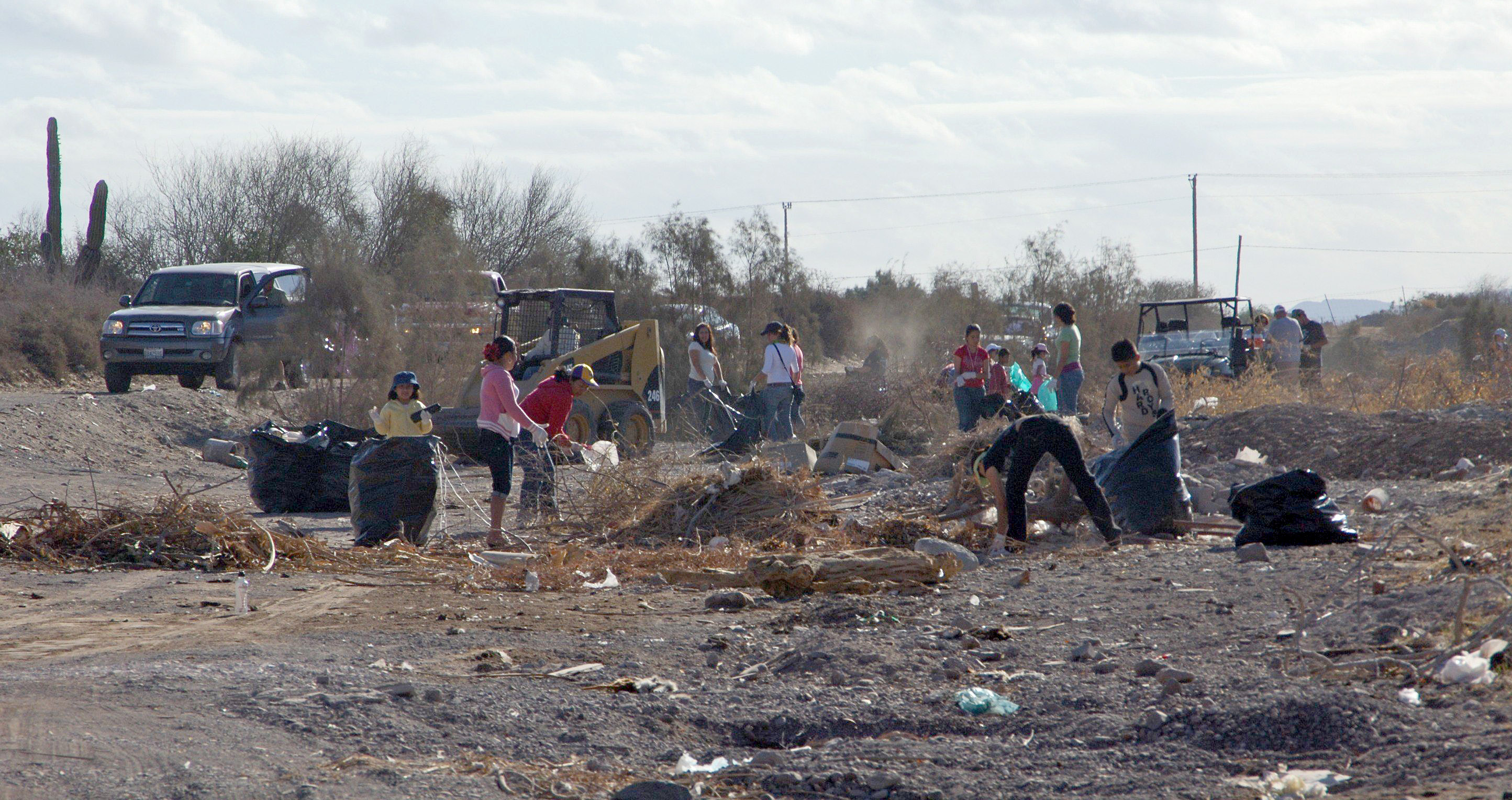
Earth Day – Loreto Pride were celebrated on April 10, 2011 with a community cleanup of the Arroyo Candeleria.  The event was sponsored by the Waterkeeper Alliance, Parque Nacional Bahia de Loreto, Loretanos por un mar lleno de vida, and Eco-Alianza de Loreto. A.C.

As in years past, the arroyo had been used by those less educated about the affects of garbage as a dumping ground for unimaginable waste.  During the dry winter season, the arroyo serves mostly as a road from Mex 1 into the beach front community, but in the rainy season, it can/does become a roaring torrent, pushing everything in its path into the Sea of Cortez.  Hence, the need to remove the accumulated refuse, and save the waters from unnecessary pollution.

Discarded Refuse in the Arroyo Candeleria

There was grousing in the community about ‘cleaning up “that” place again’ … accompanied with ‘they’re just going to fill up up with trash when we’re finished’ … but the choice of the arroyo was the right one.  Intelligent and needed, no matter who caused or created the refuse.  At the end of the day, it was the sea that won – and those who live near it and call upon it for their livelihood.

Waste management is an on-going concern for every community, not only pickup, but what to do with our collective garbage once it leaves our doorstep?  It’s not only a residential problem, but a commercial one, as well.  The nuclear fuel crisis in Fukishima, Japan heightens awareness of exactly what we humans create, and the havoc we face in disposal.  Batteries, florescent tubing, toxic motor oils, paint thinners, industrial cleaners, acids …substances poisonous enough to cause serious and even deadly harm to man.  We create them, we use them, but what do with do with them when we are ‘done’?

On Earth Day this year in Loreto, something wondrous happened.  Over 200 school age youth arrived at the registration desk, ready to put their energies into their community.  They were not the creators or the garbage mess, nor did they necessarily live in close proximity, but there they were, ready to put muscle and heart into protecting the waters that they love.

Over 200 Local Youth Signed Up to Help with the Cleanup!

Rubber gloves and contractors trash bags were disseminated at both registration, and along the cleanup route.  There was a water truck to make sure that everyone was hydrated, and multiple pickup trucks to cart the collected refuse to the dump – where is should have been deposited in the first place.

They brought friends, cellphones, and great attitudes.  In fact, I don’t think the arroyo has ever been cleaned as quickly as with this small energetic army!  There were expected ughs and gags.  I mean, not only garbage but dead animals were in the mix.

Some of the things I personally picked up : plastic, plastic, plastic (remind me NEVER AGAIN to use a plastic bag to carry something)((when it sits in the sun, plastic doesn’t degrade, it merely hardens – so that when you go to pick it up, it breaks into millions of itty bitty pieces of plastic!!)), dirty diapers, plastic bottles (yes, more plastic), tin cans, empty food containers, partially full food containers, cigarette boxes, broken and unbroken bottles, cardboard boxes, broken plastic cracks, broken trash cans, toilet paper, Kleenex, more plastic bags wrapped around cactus and trees, building materials, old bits of rubber piping, florescent light bulbs shattered into millions of pieces –

SIDEBAR : As I sat in the dirt trying to pick up as many tiny fragments of glass as possible, I was struck by the beauty of the sunlight on the shards, and my thoughts was – wow – if I were a fish or a dolphin or whatever – I’d be attracted by the shimmering beauty and for sure take a bite!  Sudden – or maybe agonizingly slow – death.

… and still more : old bricks, broken tiles, trashed appliances – and/or parts of appliances, motor oil cans, paint cans, foam cups, foam bits and pieces, school books, notebooks, papers, cigarette butts, plastic trays (does the uses of plastic never end?), plastic water bottles, lamp shades …… There was more – over 30 filled trucks and trailer trips to the dump!
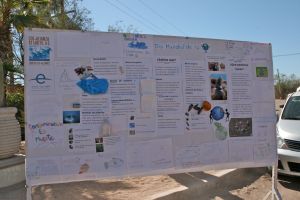
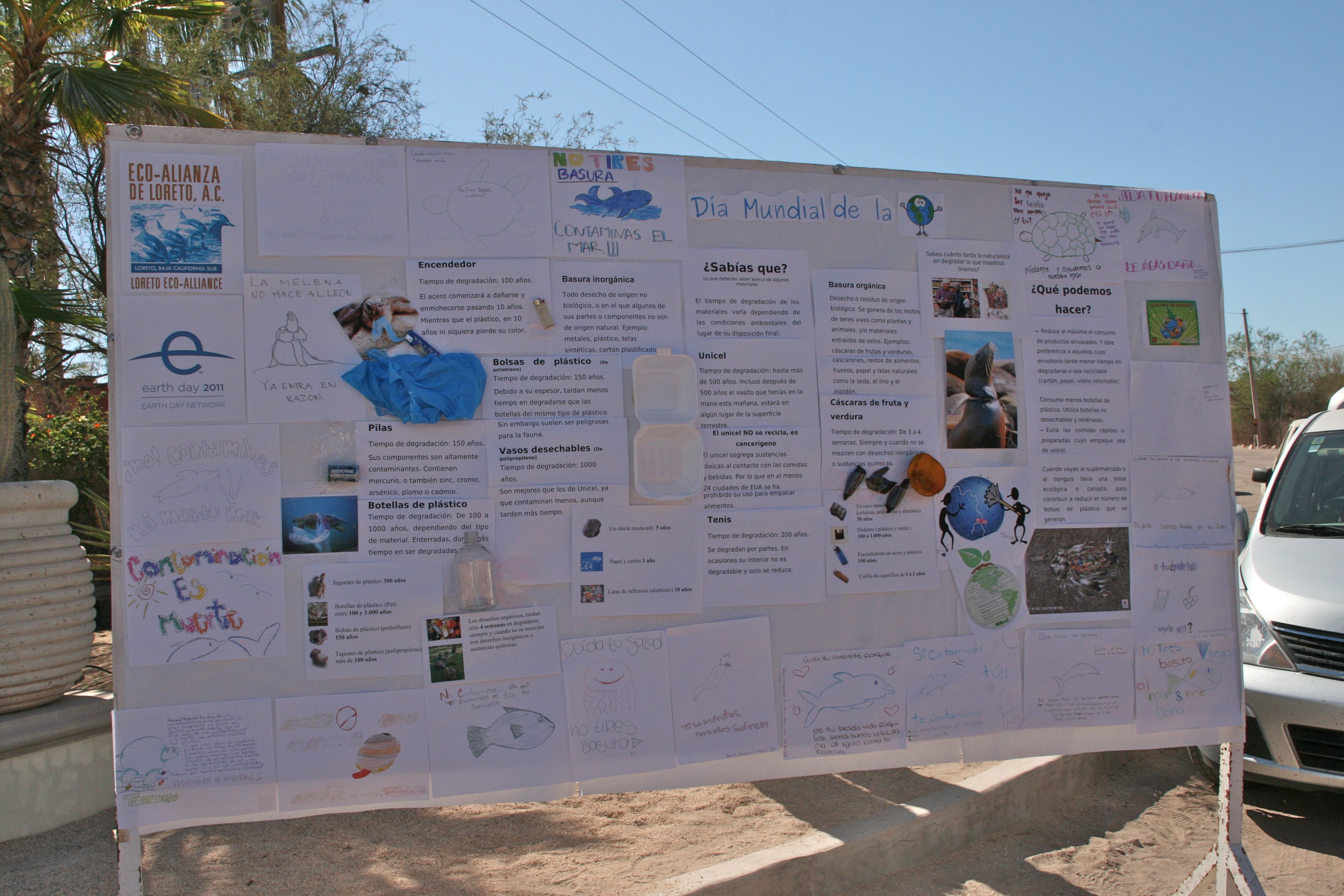
Students Created a Demonstration Board on Value of Clean Seas

And when we were done?  Amazing.  A clean arroyo, just as it should be.  Filled with mesquite and paloverde.  For a few minutes, we all sighed, smiled, and congratulated ourselves on our work… and then set to thinking how to educate those who do not understand the relationship between their actions and the health of the seas.

The crowd of dusty dirty volunteers headed up the beach to Rancho Jaral, where a celebratory barbecue was held.  Hats off to all community volunteers, including the Marine Park, ZOEFEMAT, Hugo Quintero, Tony and Linda Kinninger, Pam and Kent Williams, Mary and Nick Lampros, Catharine Cooper, the students and their participation in the EAL workshop under the direction of Edna Peralta, Program Administrator for Education and Outreach, Horacio Gabrera – Exectutive Director of Eco-Alianza, and Gaby Suarez – Program Director for the new Waste Management Program.

Water drop kisses

Afternoon Rainbow

An afternoon storm swept in quietly without much wind or fanfare.  The sky had been cloud filled, but toward four o’clock, light grey turned to dark, and heavy drops fell intermittently.

There is such magic in the desert when there is rain, especially when it passes through without floods or washed roads.  The afternoon shower was brief, but delightful.  Buster and I walked north toward the distant point, laughing at the drops, watching the birds fluff the feathers.

Vulture & Osprey Holding Court

On the branches of a tall cardon, a vulture and an osprey seemed to be holding court.  Their watchful eyes searching for food, even at some distance for the osprey from the water.

As the storm passed through, the droplets became heavier, but still felt like kisses.  All of a sudden, a rainbow – that magical golden arc of light – crossed the sky in front of me.  What a perfectly delightful way to celebrate Friday.