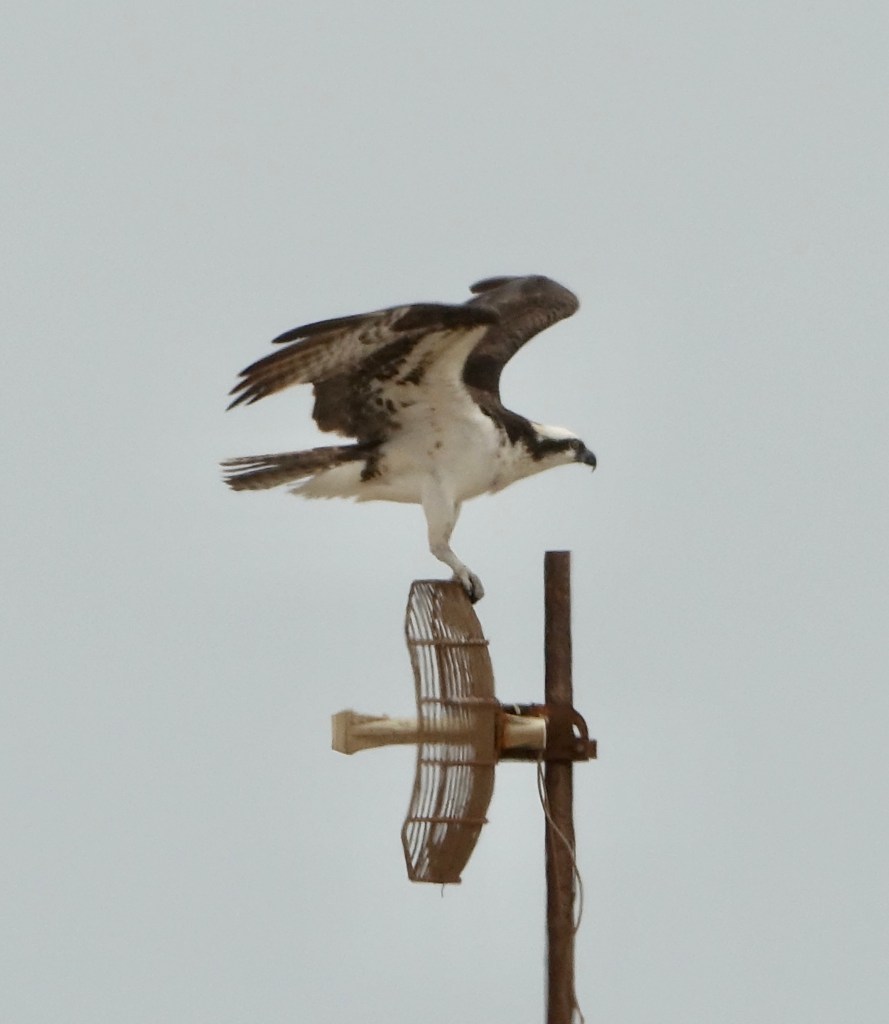
For two years, the osprey platform remained empty. A gift from my contractor, a wooden platform with a couple of randomly placed sticks perched above a tall phone-pole like wooden stand to attract the sea-hawk raptor. My belief was that the structure had been placed too close to the water, the hunting grounds for all the other waterfowl, too close for any bird in its right mind to choose as a nesting site. At the start of year three, I had it moved farther back on the property, and still, no takers. Plenty of nests in town, huge looming collections of sticks, ropes and gathered seaweed, but my platform remained bereft of bird.
And then, he appeared. A long male who one day arrived with a stick. One stick, and deposited atop the wooden structure. You could probably hear my ‘whoopee’ on the other side of the pueblo. Day after day, for hours, he sat and waited, chirping in hopes of attracting a female. Slowly, he added a few more sticks. Some dried seaweed bulbs. Some green grasses. He’d return to the nest after hunting, large fish in his talons and settle in for his meal. Each time he spied another osprey, his calls rang out across the terrain.
And then, she arrived. A slightly larger-then-he female who perched on the side of the nest-to-be and seemed to be waiting for him to make his move. He flapped his wings. He vocalized. He had her in his sights when another male showed up, and took a position on the neighbor’s weather antennae above the potential nest. Male #1. as I had grown to call him, seemed beside himself, confused as to what was more important. Chase off male #2 or get to creating a marriage with Female #1.
Eventually she grew tired of waiting and flew away. Male #1 was back to solitary. Less time on the nest, but still, but he did add a few more sticks. A bit more seaweed. Lunch and dinner of his catch. Always vocalizing his shrill call whenever another osprey entered the neighborhood.
And now, two weeks after her initial visit, Female #1 has returned. She’s decided to spend more time on the platform. I have yet to see her bring her own nesting materials to what might be her home, but I remain hopeful.
I’ve spent much of early spring fixated on nesting cameras of bald and white eagles across the USA landscape. From Big Bear Mountain in southern California to U.S. Steel in Pennsylvania, a cam in Traverse City, Michigan and elsewhere, the laying of eggs, the hatchlings, the loss of chicklets, an almost consuming watch of eagles has only whetted my appetite for an experience up close and personal on the platform at the edge of property.
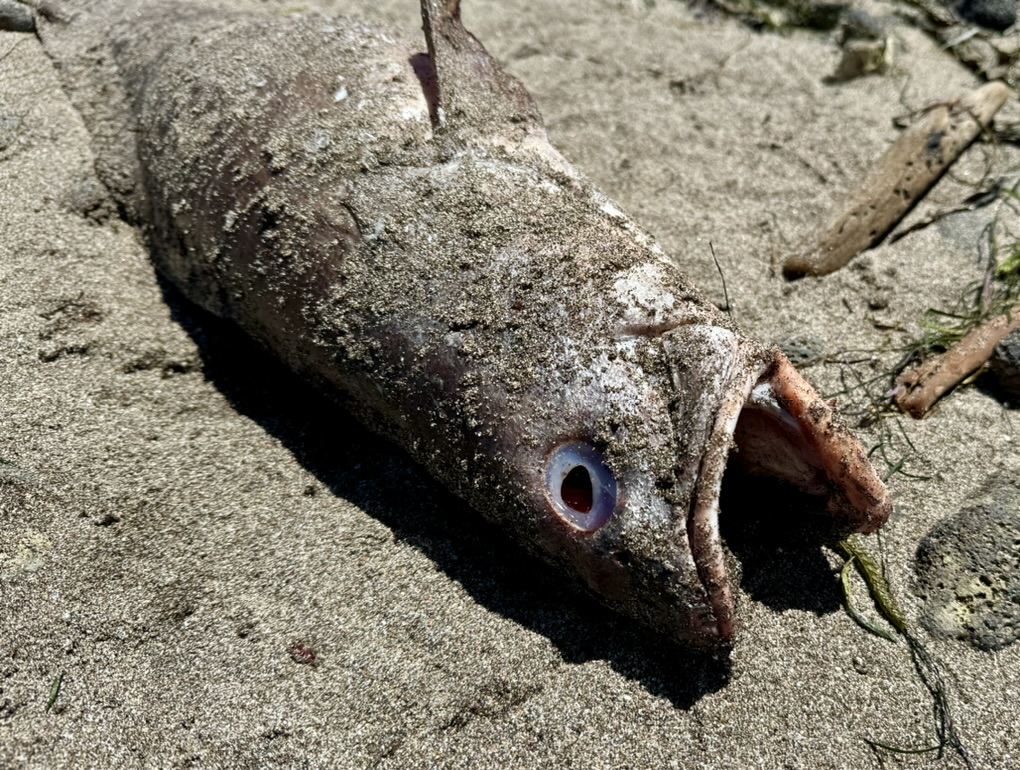
The beach was littered with small baby corals, obviously ripped from the sea floor. But why? And how? We did not have a big surf. There had been no storms. What had caused the mass landing on the sand, left behind as the tide ebbed?
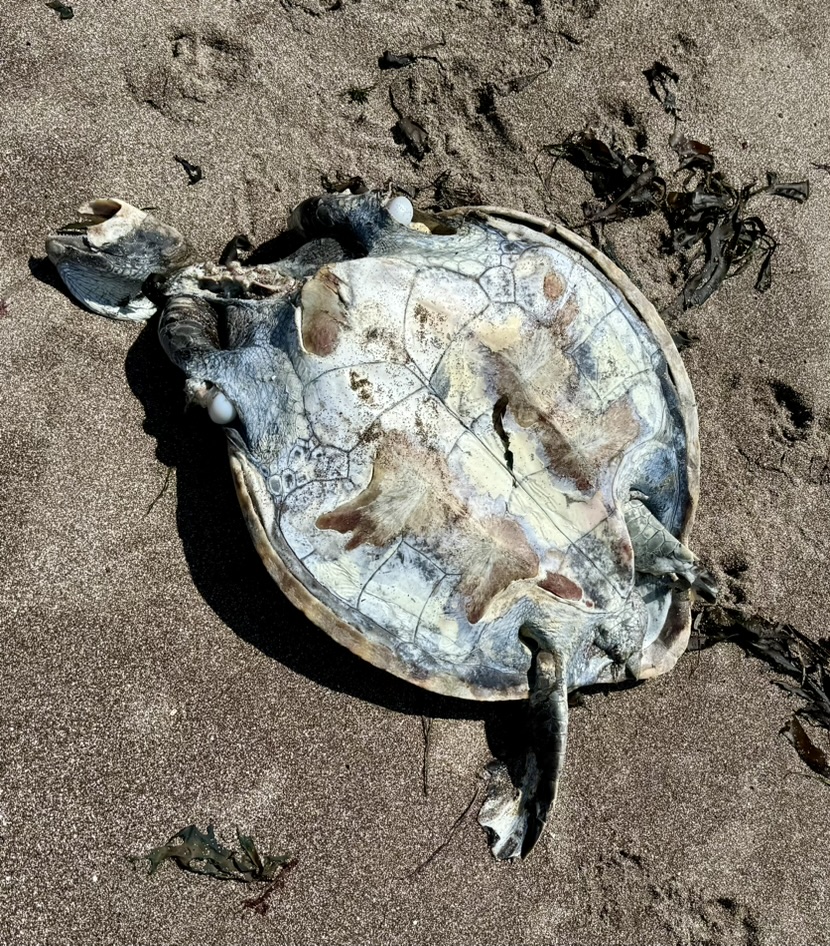
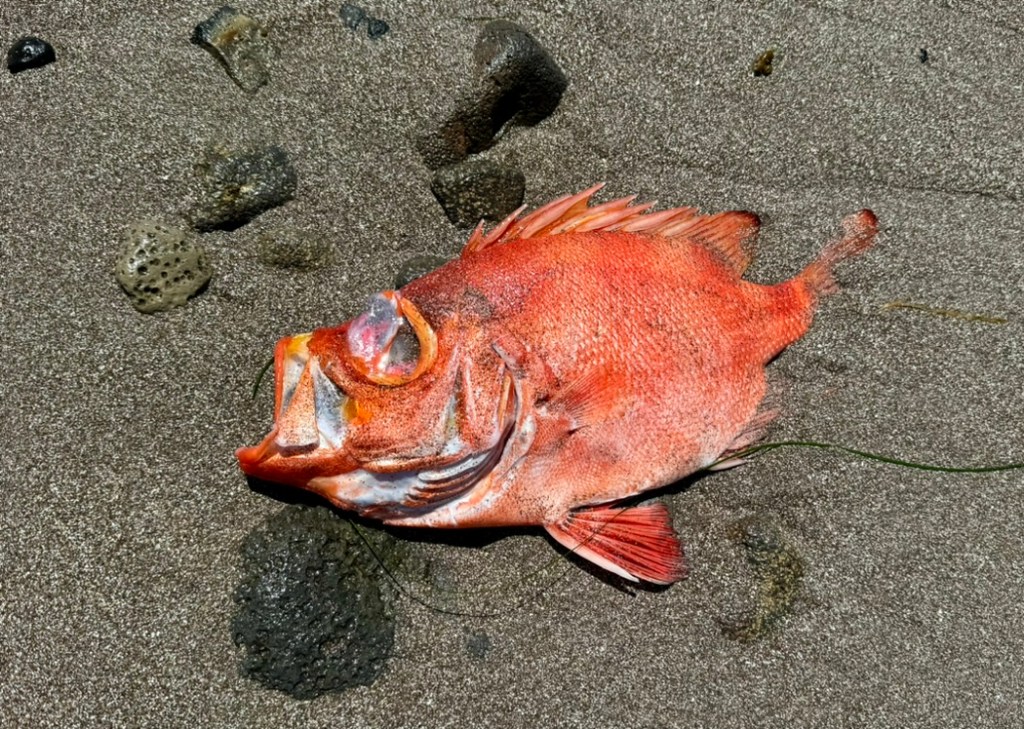
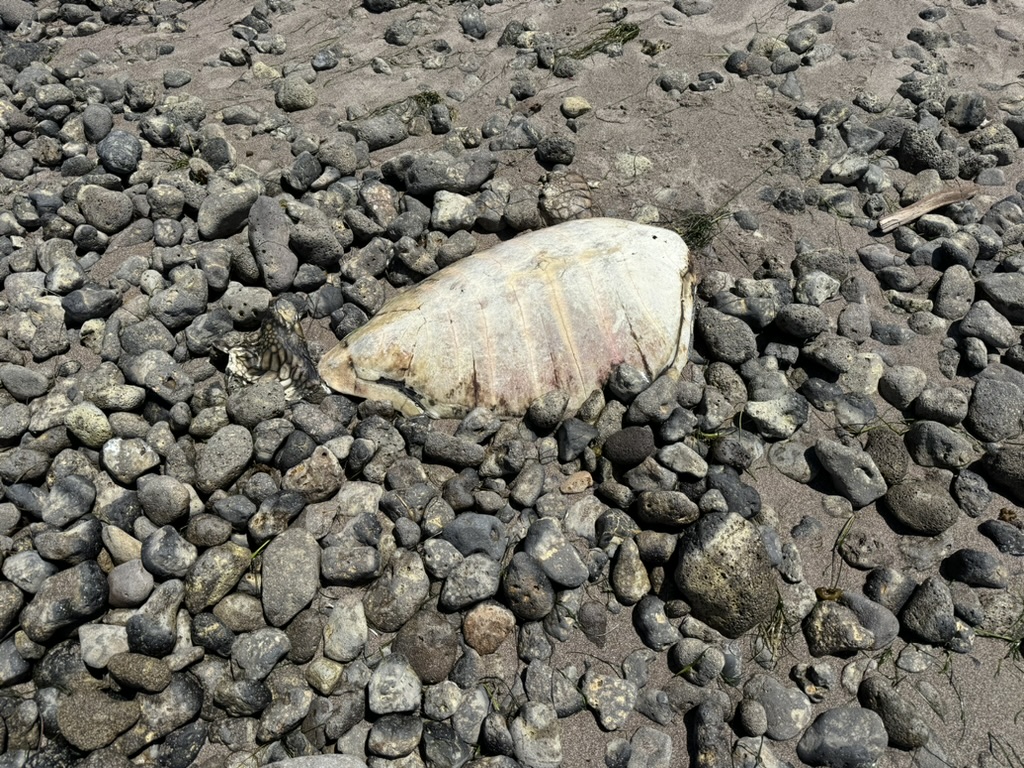
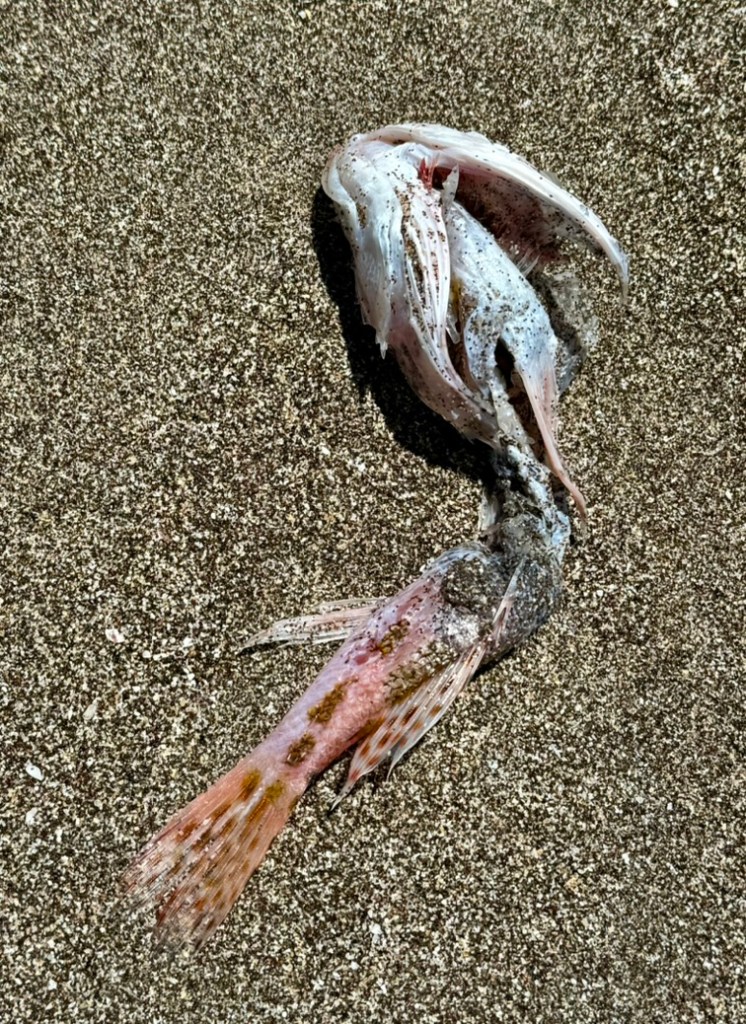
Further on, not merely coral, but eels, small fish, Garibaldi, and turtles. Fresh kill and some not so much, the carrion eaters had begun their clearing of flesh, but recent enough. Was there poison in the water? Some toxic chemical spill? But wait. I was hundreds of miles from any industrial pollution source, and we were not amid an algae bloom. My heart hurt so badly that the evening’s sleep was disturbed and uneven, visions of the dead marine life like a wave washing in and out of my dreams.
I remembered the netting. The shift from pole fishing to net fishing. And then a shift from net fishing to finer mesh netting because already, there weren’t any big fish to catch in the wide mesh net.
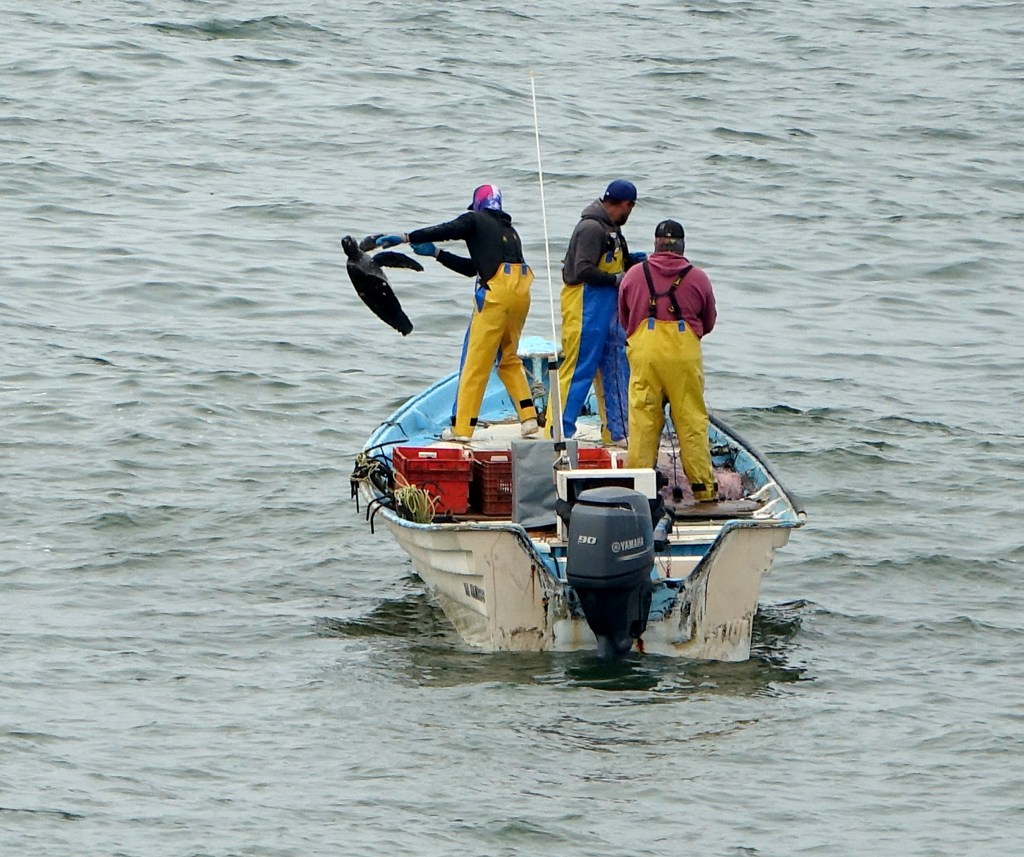
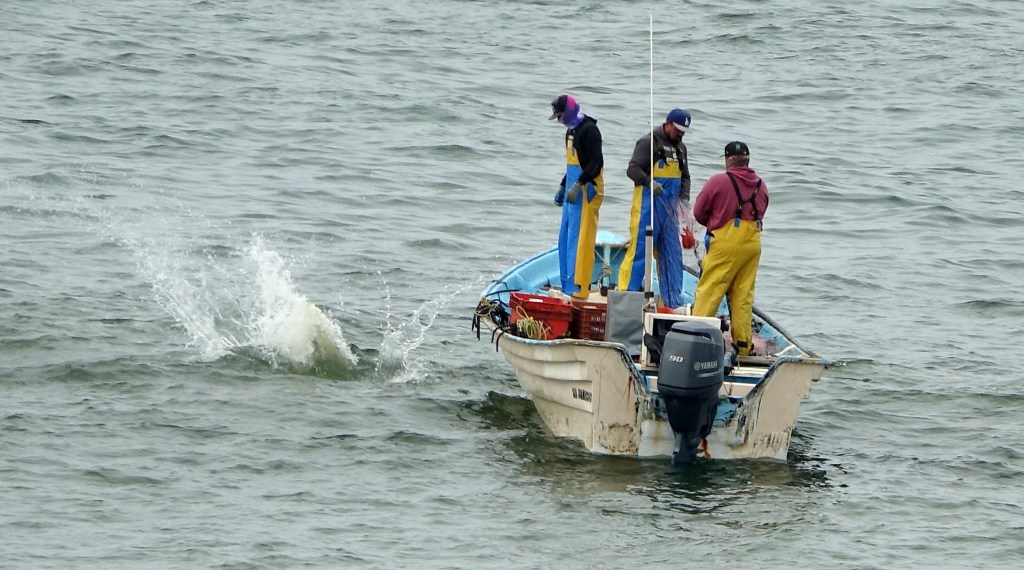
The next morning, I watched one of the panga fishers drawing in their net. I didn’t witness a single fish being salvaged, but I saw several small fish tossed back into the sea. The waiting pelicans greedily watched for whatever free meal they could garnish. It could have been my viewpoint. There must have been sell-able fish in that net.
The questions swirled in my head. I live in a small fishing community on the Pacific Coast of Baja California. The fishing has been hard hit, first by foreign trawlers that rape the sea of anything their massive operations can suck from the water, and now, even the local netting is producing less than hoped-for results. The at-market price for fish is low, and the cost of gasoline to run their boats is high.
Again, it’s a fishing community. The fishermen have no other means of creating income. They have not been trained in other skills. Fishing is a manly, macho occupation. The fishermen are proud people. And when there are no fish and there is no money, what will happen to the community?
Locals beliece the problem is one caused by large trawlers. The squid ships especially, whose nets mercilessly scrap the bottom. Unregulated. Unchallenged.
The damage from net fishing is not merely limited to habitat destruction. All creatures in the water column and on the seafloor in the net’s path are scooped up along the way. Targeted commercial species are kept to sell, but the rest of the catch, by-catch as it is known, plants, turtles, and other fish, are discarded, usually dead or dying.
Who am I to say how, where, and what the locals should fish? I am a cultural outsider, living on a saved income that allows me to reside next to the Pacific, my dearly loved and cherished body of water. What are the answers? How do you convince someone who is hungry that they should stay hungry so that later, they might be able to encounter more bounty? Science has shown us that Marine Protected Areas (MPAs) work. Small fish sheltered in protected waters grow up to be big fish that swim out of the sanctioned area, replenishing the species. Mexico has successfully implemented MPAs in many locations, Cabo Pulmo and Loreto being two examples, but limited and declining resources and lack of enforcement challenge regulated waters. Education is a key factor in every environmental concern, and too often in short supply outside population centers.
When I saw the coral on the beach, the round, spongy carcasses drying in the sun, I immediately thought of how the coral are fish nurseries, protection of food sources, crab and lobster habitat, and the very column of life that begins on the ocean floor. I thought about my community and wondered if they realized the long-term damage that short-term netting may have caused. I wondered if it was even in my place to say something.
I realize what I am experiencing is a small microcosm of a global issue. In that vein, I continue to believe that education, beginning with youth, is the foundation for potential solutions and health. In the meantime, answers are developed from collective thinking.
How do you tell a hungry man that he cannot fish? You don’t. You hold optimism in your heart. You ask, and you ask again, what can change the course? The bounty of the sea is not unlimited.
Catharine Cooper is a writer, surfer, and painter. She lives on the southern Baja coasts – both the east and the west – with her dog, Loki.
It’s the hour of fishing, or so I’m coming to know. I’m bobbing on a 23’ boat, the sun hasn’t shown its face, and I’m mentally measuring the distance to shore. Could I manage to swim in for a cup of really hot coffee?
Why am I here? Oh, right. I wanted to learn to fish, and my girlfriend’s husband, Barry, volunteered to teach me. I stumbled onto his boat this morning, and here we are, somewhere near Isla Coronado in the Sea of Cortez bobbing up and down in the pre-dawn hour. The sea is dark and the sky is just beginning to throw hints of pink.
I’ve got a rod and reel, a box full of pretty hooks, sinkers, and lures that are brightly colored and dressed up with fuzzy things – and no real idea what any of what to do with them.
Our mission, so I’ve been told, is to catch bait before we go farther out to actually catch fish. Isn’t that what we are doing? Why do we have to do it in the dark? Barry says it has something to do with the angle of the light, that bait fish are hungrier in the early hour.
On the end of the line attached to my reel I’ve fixed a small leader with 8 tiny hooks. The idea is to feed out the line until I feel a ‘bump’, then quickly – so the fish don’t swim off – reel the line back in. Just before the fish break the surface, I’m supposed to execute a delicate pirouette and swiftly lift the attached bait over the lip of the deck and deposit them into the gurgling water tank. Any missteps in this procedure, and the small sardines will fly from their hooks and be lost back into the sea. I know this, because I’ve already lost eight. I’m getting cranky for breakfast.
Finally, I pull my ‘strand’ onto the boat with four small fish attached. I am ecstatic until Barry points out that two of them are mackerel, which means I have to toss them back. “Weak fish,” he explains seeing my disappointment. “They’ll die in the tank before we can use them.” He’s already caught 12 sardines, and decides we have enough to go after bigger fish!
Scottish writer, John Buckam once wrote, “The charm of fishing is that it is the pursuit of what is illusive but attainable. A perpetual series of occasions for hope.”
His words will aptly describe my day.
Barry tells me my pole is too long – better for rock fishing than sport fishing – and shifts me to one of his that is short and sturdy. He shows me how attach the bait to a fat hook. With a small net, I corral one of the sardines in the tank and bring him to the surface. As Barry holds him, I drive the hook through the roof of his open mouth and out the top of his head. I try not to look into his eyes or think about how much this must hurt. Now that I have him hooked, I toss him over the side, give thanks for his sacrifice, and let him swim gladly away from the boat.
Get me a big fish, I telepath after him. Get me a big fat fish! I imagine him below swimming in his watery fish world, looking for friends his size and kind. Then I imagine bigger fish coming to find him, to eat him. And voila! I’ve got a bite and I’m reeling in my line. This is easy!
“Careful,” advises Barry. “Slow and steady.” The fish ‘runs’ with the line, my reel wildly spinning as I keep one finger over the line so it doesn’t tangle. I let him swim until I feel a pause. Then I go back to reeling, which is not as easy as I had initially thought.
The fish is heavy, or a fighter. Whichever the right word, my arm is tired from trying to finesse holding the pole, feeding the line across with my left finger, and reeling with my right hand. I keep telling myself, this is fun, as the muscles in my arms burn like fire.
Finally, an astonishingly beautiful blue/green head breaks the surface. “Dorado,” Barry proclaims. The fish shimmers in the sunlight, a green iridescent color against the turquoise water. He’s got a flat face, a kind of pouty mouth, and a long deep blue dorsal fin. His tail splits in a wide yellow-green V. I’ve caught a fish!
When I pull him to the boat, Barry asks me if I want to keep him. “He’s kind of small,” he says. Small? I’ve just wrestled this fish for ten minutes and it’s small?
“Cut him free,” I answer, and with pliers and a pair of gloves, Barry dislodges the hook from my dorado’s mouth. I look into his dark fish eyes and thank him for making my morning. Then, off he swims, hopefully to grow bigger.
Barry catches the next two – both dorado – and returns them to swim another day. I’m beginning to understand the ‘sport’ in fishing. What he’s really after are wahoo, a prize fast swimming game fish that can weigh up to 180 pounds, which is also excellent eating.
We take the hooks off our lines and lay out the brightly colored lures to choose exactly which one we think (or Barry thinks) will attract the wahoo. Slowly, I’m learning the difference between all the things in my tackle box. Barry has me change the liter to wire. Seems wahoo’s teeth can snap clean through filament.
We shift from drift fishing to trolling at around 9 knots. Instead of hand-holding the poles, he sets them in rod slots, leads the lures just beyond the engine wake, and kicks back in his chair with a beer.
A pod of dolphin sights the boat and swims in to surf the bow. I rush to the front and watch with joyful glee as these playful creatures leap, spin and dive back and forth in front of the hull. I feel childlike in their presence and relaxed.
From a dark morning to a brilliantly sunny afternoon, the Sea of Cortez shimmers in the mid-day light. Deep cerulean blue surrounds the boat. A green sea turtle swims past and in the distance, a pod of pilot whales rolls on the surface. Blue footed and brown boobies dive for small fish, while split-tailed magnificent frigate birds soar overhead.
A pair of sleeping sea lions, the rolling fins of lazily drifting marlin, and a large formation of pelicans round out the vista. The offshore islands beckon with small turquoise rimmed beaches
If something bothered me yesterday, I don’t remember it. The comfort of the sea and this new adventure of fishing has washed away any cares I might carry of the rest of the world.
We don’t hook any Wahoo, but it doesn’t matter. Well, not much. I’ve learned new skills and had such a glorious day on the water that it’s hard to hold any negative thought. But I can sense Barry’s disappointment.
Already, I understand the essence of “…a perpetual series of occasions for hope.” It must be this reason that men go to fish again and again. When I step off Barry’s boat, I thank him profusely. And then, like a true fisherwoman I say, “Just wait until next time.”
(First published in 2011, in PRESS PAUSE MOMENTS, a collection of short stories edited by Anne Witkavitch)
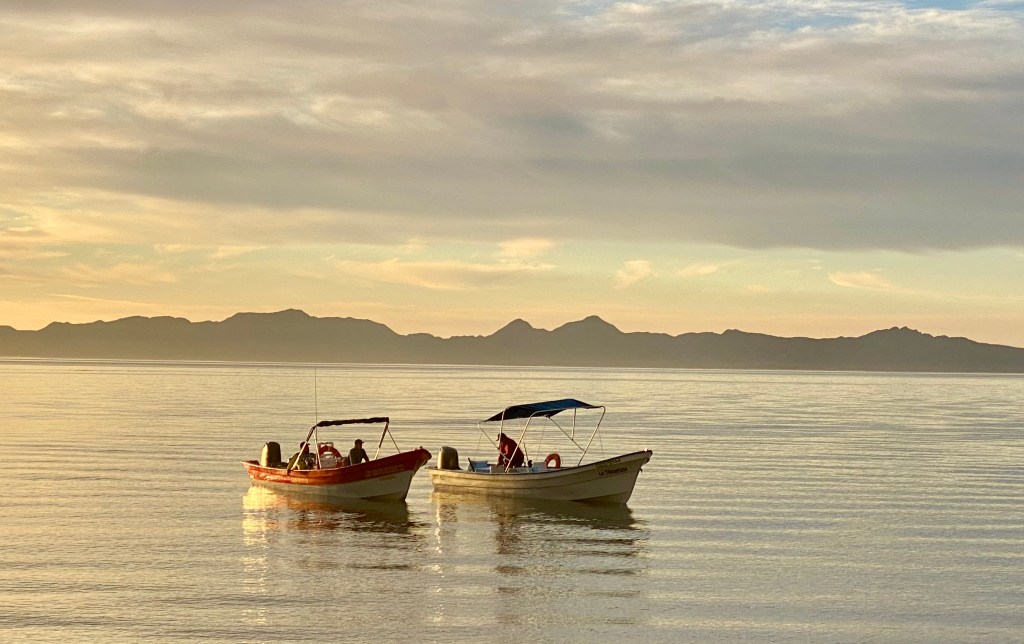
Imagine waking to the gentle slapping of sea water on cobble and sand. Hearing the chatter of terns overhead as they search for fish. Watching a flotilla of pelicans glide inches from the surface of the sea.
Imagine, your days transport for fishing or island hopping, a pangero, pulling up on the sand in front of your Casita.
More of the magical ways to begin a day in Loreto.
Not just any fish, but a fish on a coral reef, swimming with my brightly colored friends. Together we made up a palette of blue, lavender, yellow, gold, orange, pink, green and silver scales, fins, tails and mouths. Our motions fluid. Our community hierarchy long established. Big fish eat little fish. Great white sharks down to the tiniest plankton and krill. Fastest fish wins the chase. Hiding places and ability to change color can save a life.
But something was different.
Something in the water.
Or lack of – on the water.
There were no nets to tangle or strangle us, or our warm-blooded mammal friends, the dolphins and sea lions. There were no hooks dangling from lines with bait. My friend once nibbled, and was gone, whipped to the surface, never to return. A different kind of predator.
Something was happening on the water.
No pleasure boats.
No tankers. No cruise lines.
I could see the blue sky and shimmering ripples of sunlight. No gooey oil sheen spewed from motors. No sinking puddles of dark black goo settling on the sea floor. No man-made gunk. No cast-off plastic bottles, paper plates, napkins, party balloons, straws, or discarded food. The sea was like a mirror on windless days. At night, I could see the stars, and the flickering light of the moon fingered across the reef and the sandy bottom. My friends and I frolicked and multiplied. We rolled with the tides and spun with the currents.
For a few months in 2020, in the time of COVID, the humans left us alone.
It’s true for all of us – worldwide – global. Life as we knew it changed with rise of an invisible, silent, and killer virus transmitted between humans by vaporous breath.
Baja did not go unscathed, but at the time of this writing, my sweet “Pueblo Magico” of Loreto, has survived with zero cases. The population has maintained its physical health through many of the same strategies practiced in other parts of the world: social distancing, mask wearing, and for those entering town, temperature taking and confirmation of residency. A cadre of devoted volunteers insured that the local hospital was fully supplied with masks and PPEs, should the need for treatment arise.
Airlines stopped carrying passengers in and out of Loreto in April, but now, come June, weekly flights are again scheduled. Alaska Airlines has added Saturday only flights, and those are carefully booked to provide distancing between passengers. It is my understanding that masks must be worn from check-in to disembarkation. Seems smart to me.
Loreto, like the bulk of cities and towns in Mexico that depend on tourism, has been badly hurt economically. Food drives developed through grants and donations provided both locally, and under the aegis of the International Community Foundation, have assisted with keeping food in the mouths of the most affected and needy. Eco-Alianza de Loreto, through the overwhelming support of their donors, initiated a voucher program, that will continue to provide much needed assistance throughout the summer.
June in Loreto. Restaurants slowly begin to offer more than take-out service, and shops other than grocers open their doors, while everyone looks toward a change in the season.
Sultry morning hunter ……..
Hot and sultry – those are the marks of summer on the Sea of Cortez, the fishing shifts to those species that like warmer water: yellowtail, dorado, marlin, wahoo. Seabirds move more slowly. Life is steady and calm. Easy days on the hammock for reading material consumption. Cold beverages in the afternoon.
Slowly, we inch toward our new normalcy.
Hopefully, we will remember some of the insights gained by being forced to stay still. Hopefully, we have expanded our ability to hold open our hearts, increase our empathy and personal understanding of both our frailty and our strength. Hopefully, we are ever more aware of our shared humanity.
While most thoughts of Mexico in the winter are of sunshine filled days lazing or frolicking on the beach, there are still those that sneak in – like this morning – cloud filled and gorgeous – and yes, chilly.
The beach walkers bundled up in sweatshirts and even down jackets. Ugg boots, or at least fat socks and tennis shoes, instead of flops and beach shorts. Their pace is a little quicker to fend off the cold.
Winter in Baja.
A place where pelicans, boobies and arctic terns dive for bait fish in the shallow waters close to shore. Where egrets and herons patiently hunt on the shoreline or in the estuaries, side by side with sandpipers, godwits and occasional killdeer. Where offshore, orcas, fin whales, dolphin, and dancing mobula entertain guests and locals, while we wait for the arrival of the blue whales.
A place and time for contemplation. The hunkering down that winter begs of the body and the mind. A hibernation of such, so that when spring unleashes her torrent of renewed growth, we are fresh from rest and ready to press forward again.
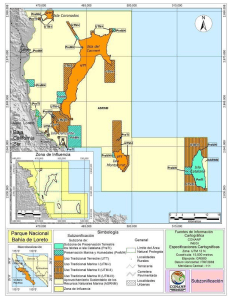
New Park Management Plan for Loreto Bay National Park
Mexico’s Federal Register published the revised Loreto Bay National Park Management Plan in April, 2019. This supplanted the 2002 version, and expanded to 510,472 acres protected waters and lands.
The plan is the result of a thousands of hours in 10-year process of scoping meetings to build capacity and consensus. These meetings were held with the participation of scientists, fishermen, tourist service providers, trained facilitators, conservationists, economists, and several non-profit organizations.
The newly released plan divides the Park into 7 different sub-zones and expands the areas of protected and no-take zones. The objective of this plan is to protect habitats critical for biodiversity, rare ecosystem, and satisfy the needs of local fishermen and visitors to the area.
To learn more about the details, click on the Eco-Alianza link below.
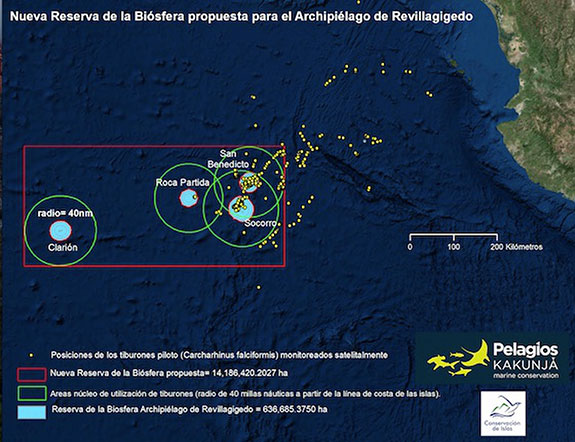
The federal government has designated 40 square miles south east of the Baja peninsula as a shark sanctuary. It was being commercially fished, with only six miles around the four volcanic islands safe for the top of the food chain predators.
But researchers found that the big guys travel away from the islands as they cruise between the islands, and that’s when they’re vulnerable. These predators are necessary to keep marine life in balance. And to fuel Hollywood movies.
Here is a map of the newly protected area. The yellow dots represent sharks that have been tagged.
The Mexican Navy has agreed to patrol the safe area with boats and drones, while the Pew Charitable Trust will peek through satellites.
The sharks took it well, breathing a collective sigh of relief, and promising to stay within the new National Park.
Fishing, mining and new hotels will be prohibited in the ‘biologically spectacular’ Revillagigedo archipelago
Finally a leader with the environmental intelligence to recognize the critical need to protect our ocean resources. Thank you President Nieto.
Mexico’s government has created the largest ocean reserve in North America around a Pacific archipelago regarded as its crown jewel.
The measures will help ensure the conservation of marine creatures including whales, giant rays and turtles.
The protection zone spans 57,000 sq miles (150,000 sq km) around the Revillagigedo islands, which lie 242 miles (390 km) south-west of the Baja California peninsula.
Mexico’s president, Enrique Peña Nieto, announced the decision in a decree that also bans mining and the construction of new hotels on the islands.
He said on Saturday that the decree reaffirmed the country’s “commitment to the preservation of the heritage of Mexico and the world”.










 Thanks to Gringo Gazette for the following:
 Baja Dreaming
You must be logged in to post a comment.