6:30 AM : Loreto – 5:30 PM : Los Angeles
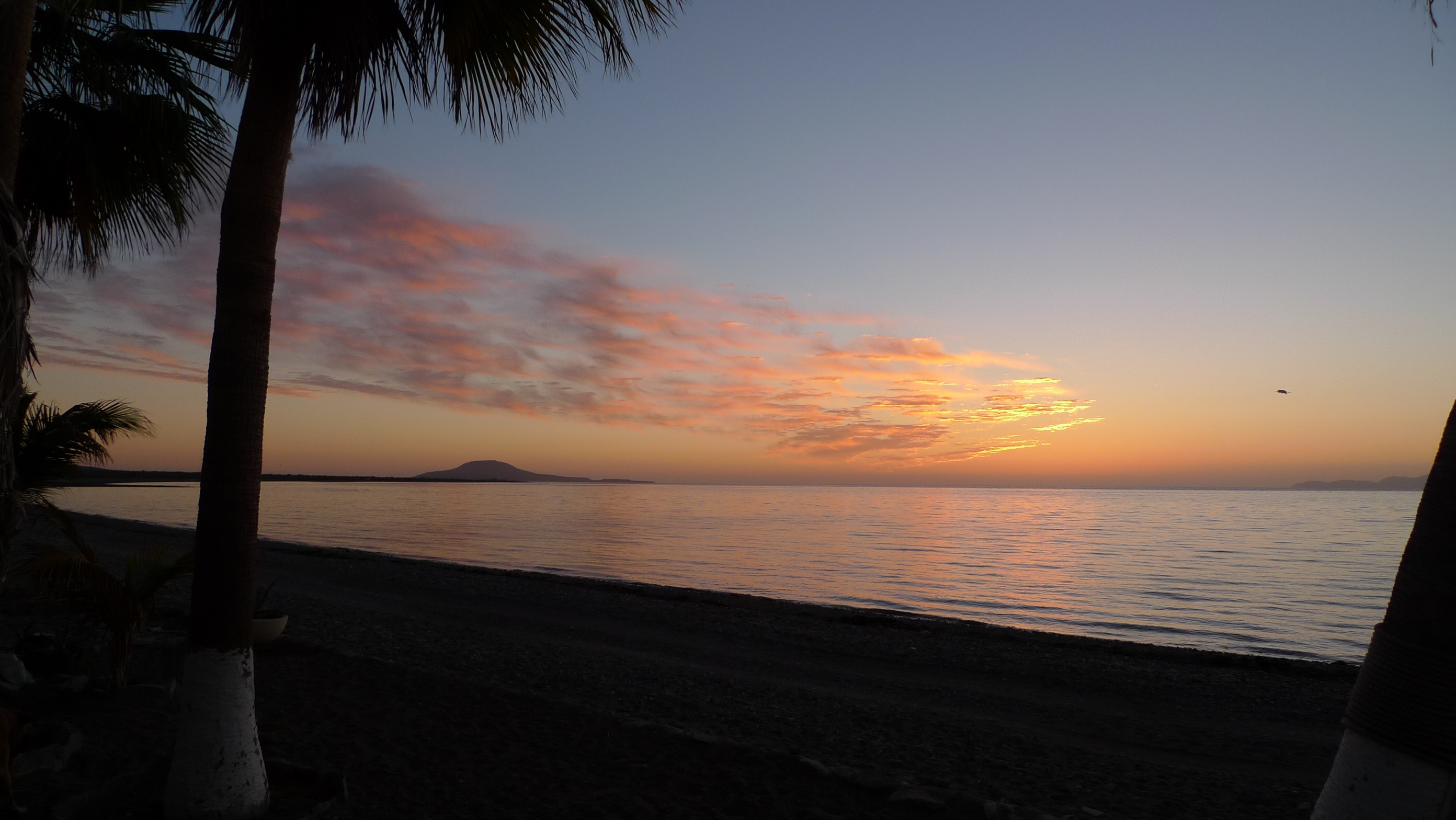
6:30 AM Loreto Sunrise

5:30 PM The Greater LA Basin
6:30 AM : Loreto – 5:30 PM : Los Angeles
6:30 AM Loreto Sunrise
5:30 PM The Greater LA Basin

Loreto Sunrise
Quiet seas and shimmering dawn. Early morning osprey calls. The whiz of hummingbird wings next to my face. The splash of hungry pelican. A brisk walk to a thought provoking seminar by Mark Spalding the Ocean Foundation on environmental governance, part of the three-day Simposio de Ciencia de la Conservación en Loreto (Conservation Science Symposium). A vulture parked atop a palapa waiting for???
A seven mile SUP on glassy blue green seas filled with fleets of small yellowtail, puffer fish, sulking rays, fat faced puffer fish …. and … a sea turtle! First time paddling I’ve had that kind of up/close encounter. Cormorants and gulls. Lots of wonderful messages from friends all over the world.
Now, to hop a flight back to the states just in time for dinner with my mother, Kay Wright. It just happens to be her birthday, too! Happy Birthday, Mom ….

Stunning Blue Button photo by National Geographic photographer, David Liittschwager, 2007
A new sighting – for me – while SUPing this afternoon in the Sea of Cortez. Curious deep blue ‘buttons’ floating/drifting on the surface. I don’t remember seeing them before, and with homage again to the power of Google, the mysterious creature has been identified.
Blue Buttons are tiny inch size spheres with hair like tentacles that lend a jelly fish like appearance. Not real jelly-fish, but a sea organisms called Porpita porpita, their tenecles are
A wikepdia definition yeilds the following information:
Porpita porpita[1], commonly known as the blue button, is a marine organism consisting of a colony of hydroids[2] found in tropical waters from California to the tropical Pacific[3], the Atlantic and Indian oceans[4] It is often mistaken for a jellyfish, but although jellyfish and the blue buttons are part of the same phylum (Cnidaria), the blue button is part of the class Hydrozoa.The blue button lives on the surface of the sea and consists of two main parts: the float and the hydroid colony. The hard golden-brown float is round, almost flat, and is about one inch wide. The hydroid colony, which can range from bright blue turquoise to yellow, resembles tentacles like those of the jellyfish.[5] Each strand has numerous branchlets, each of which ends in knobs of stinging cells called nematocysts. The blue button sting is not powerful but may cause irritation if it comes in contact with human skin.[2]
It plays a role in the food web, as its size makes it easy prey for several organisms. The blue button itself is a passive drifter, meaning that it feeds on both living and dead organisms that come in contact with it. It competes with other drifters for food and mainly feeds off of small fish, eggs, and zooplankton. The blue button has a single mouth located beneath the float which is used for both the intake of nutrients as well as the expulsion of wastes.
It is preyed on by Violet Sea-snails of the genus Janthina [6].
What a treat to paddle with the tiny blue floating discs all around me. Since they are defined as living in tropical waters, my sense is that their appearance means that the water is warming up – somewhat early – and the summer just may be a sizzler…
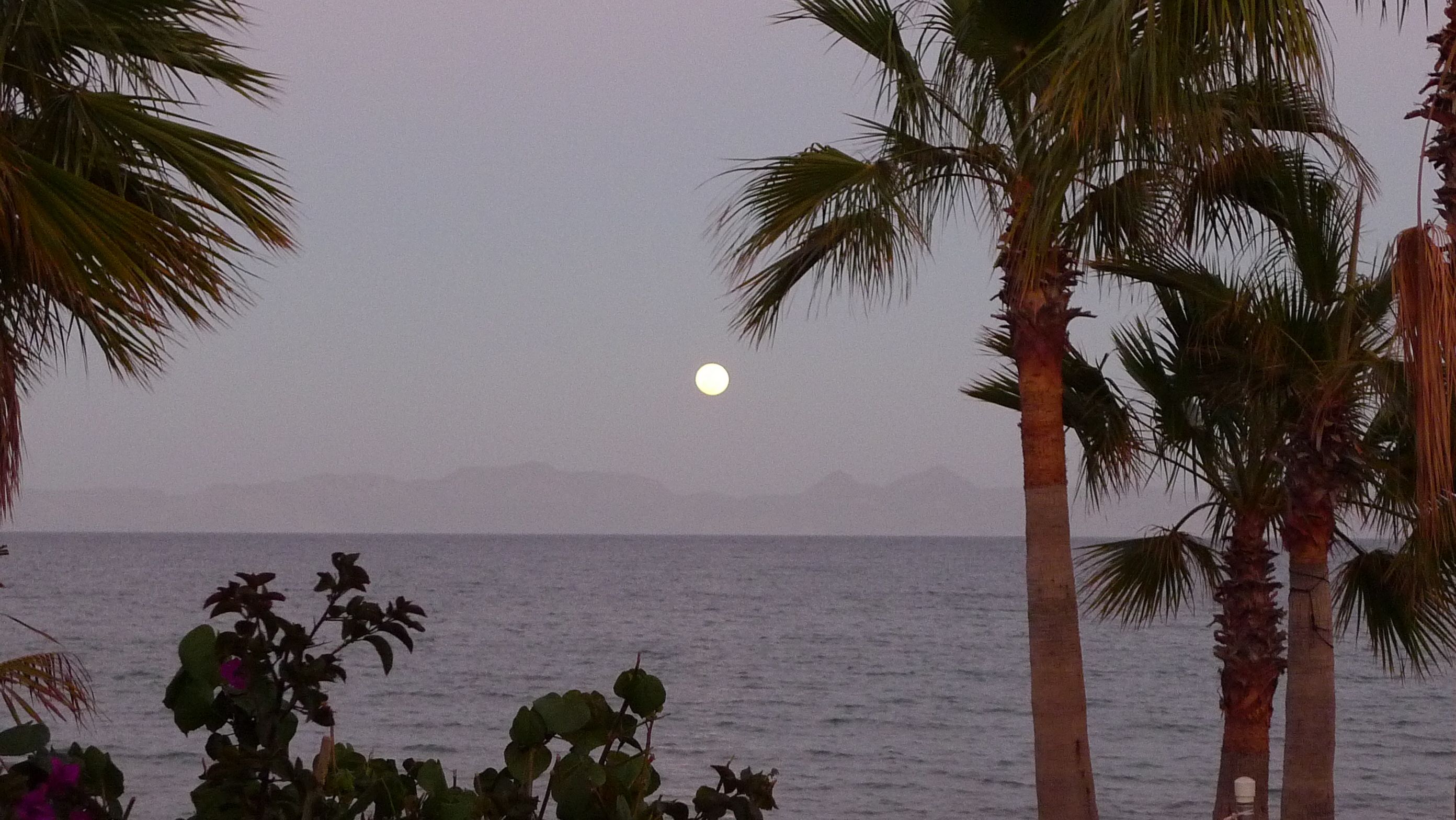
Full Moon Rising : Loreto
Once again, she slips from under cover of island and sea, shimming up the sky toward the heavens .. lighting up everything in her path .. Full moon rising …………… How sweet the night …

View through palms across lap pool
My good friends, the Boyds, are selling their lovely waterfront home. It sits directly across the Malecon on the Sea of Cortez with stunning sunrise vistas of Isla Carmen, shorebirds and nearby marine mammals. Within walking distance to everything, the property has expansive gardens, a heated lap pool, state of the art kitchen, and is primed for expansion into a small bed and breakfast, if an owner should choose. Currently 3 bedrooms, with 2 full and 2 half baths, wine bodega, separate guest casita and extra storage. For more information and additional photos : http://www-loreto-waterfront-estate.com

Sunrise, Sea of Cortez, December 31, 2010
Last day, last sunrise of 2010.
Woke earlier than usual : 4:00 AM and what to do. Sleep filled and nothing left but to meditate and greet the new day in darkness. Poured hot coffee and savored the quiet. A crescent moon lingered with Saturn clinging to its sphere. NASA reporting storms on the ringed planet .. new information on how things in the planetary world are created.
All the dogs come for morning treats, and still it’s dark. They chew, I sip .. and then I give it over. The hint of light coming from behind the island beckons me. I tie the laces on my shoes, grab the camera and off we go, down the long beach toward the distant point.
The air is chilled and the wind still from the WSW as it has been for days. The sea has been strange with this blow. The beach houses block the wind right at the waters edge, creating surreal glassy pools, while just beyond the roof lines, ripples fan out toward the island and the open water.
The seabirds have been luxurious. Terns, cormorants, grebes, egrets, herons, an osprey .. pelicans, boobies, gulls, sandpipers, marbled godwits, sanderlings, lesser yellow legs. As if everyone has come to celebrate the end of the year. Even the dolphin have moved closer in the shallows, savoring the small bait fish that swim nearer to shore.

Estuary at Dawn
At the edge of the sea, and running westward to the Pacific, lies the gorgeous extremes of the Baja desert. Dry and subtropical on the eastern shores, the climate and plantlife are part of the Sonoran region, a part of one of the the largest and hottest deserts in North America. Tall cardon, a relative of the saguaro cactus stand like tall sentries amidst mesquite and paloverde trees.
Estuaries are common on the eastern shores, with wading birds in wild variety and large numbers. Migratory birds, such as the Arctic Tern, make use of Baja for their winter home.
Buster and I walked into the morning light, solitary figures on the long stretch of beach that spreads north from town. We walked for over an hour with not a single person in sight, but plenty of heron, egrets, pelicans and cormorants.

Heron gliding northward along the beach.
The squawk of the heron as Buster flushed him from the shallows echoed down the sandy shoreline. He landed again and again, only to pick up his wings again as we grew closer.
Finally, the sun slipped up behind the edge of Isla Carmen in a beautiful – if not momentary – display of color – before tucking behind a bank of clouds. We turned back toward home. I was thinking coffee … Buster was thinking dog treats.

Buster leads the way on our morning walk.
So began the last day of the year .. Filled with gratitude for all that has come to us, all the experiences, all the learning .. the friendships, the adventures, the joys, the challenges and the successes.
the sun crested the isla carmen one minute earlier this morning : 7:14 instead of 7:15 .. yes, the shortest day and longest night have passed … there must be a metaphor in this.
the air is still and warm. no waves and hardly a ripple on the water. i find this magical, as i continue to drink in living in such close proximity to the water .. a constant that defies my emotional ups and downs, the comings and goings of friends, the wild off-road racer revving his engine somewhere in the distance, the cock-a-doodle do, and the grazing of cattle on the flowers and trees in my garden. i wish i could craft a plan – to do something more to protect her, to nourish her .. as i write that, i remind myself to listen .. that the messages are always present, it’s merely plucking one or the other from the chorus ..
a pelican dives for fish. his splash is another of the sounds that burn into my memory bank. yesterday hundreds of blue-footed boobies diving in formation like fighter planes .. my joy expands ..
Sunset paddle with Buster on the bow of sit-on kayak. Sky a soft palette of pale pinks and corals with a hint of light violet. Wind driven waves of about a foot bounced the boat around. We drifted near a gathering of pelicans and gulls, listening to their ‘conversations’ over the splash of crested water. Overhead, terns and boobies called to one another and dove for small fish meals.
The sea began to wear the colors of the sky. Bird songs blended with water songs. Oh glorious end of day .. oh magical way to live.

Tuna Boats : Maria Veronica & her sister ships
Off shore, three tuna boats have sat at anchor for the last four days. At first, I had been told that they were National Geographic research ships and I was thrilled that they had stopped in Loreto. When I discovered that they were anything but research ships, my heart felt a deep sadness.
Perched on top of each vessel is a helicopter which is used to spot schools of tuna. What chance does a tuna have against a helicopter? Oft times, dolphin swim in the same schools, and become innocent prey in the fishing fleets nets. While the local seas are all part of Loreto National Marine Park, and commercial fishing is prohibited, the necessary enforcement is all but non-existent. The boat captains know all to well that there is nearly no one to stop them, and so our seas suffer. Local fisherman complain that both quanitity and size of all local catch has diminished in the last decade. It is these long lingers that are mostly to blame.
I scanned the hulls of the ships looking for a name. The largest of the three is Maria Veronica. A quick Google and I pulled up more distressing information. A posting in 1995 about the vessel and her tactics made me furious to see her sitting with her sister ships in our waters.
Here’s what the poster said:
Tuna Meltdown :
On November 9, 1995, I was aboard the dive boat Don Jose. We were anchored on El Bajo seamount, a dive site in Mexico’s Sea of Cortez renowned for an abundance of marine life, including schools of hammerhead sharks. Small groups of divers were going out in skiffs to drift dive over the seamount. Between dives I saw pods of dolphins and noticed a small helicopter circling the area. Shortly after that the tuna ship Maria Veronica arrived.
In a matter of minutes, without any warning whatsoever, the tuna boat and its tender dropped a net directly across the bow of the Don Jose. Within moments, the tuna net encircled the entire seamount. Inside the circle of net was one of our skiffs with four divers aboard. If these divers had been in the water, they surely would have been killed.
The Don Jose’s captain quickly cut our anchor, which had become entangled in the tuna net. As we left the area, we watched the Maria Veronica cut its net and ditch its equipment. Our captain radioed the Maria Veronica for an explanation. We were told that the spotter helicopter saw the pods of dolphins and a large dark area under the Don Jose and concluded that the seamount was a large school of tuna. Furthermore, they said that they were unaware of the seamount’s existence because it was not identified on any of their maps; they were also unaware that we were anchored and that we were diving, since no dive flag was flown. While it is true the Don Jose was not flying a dive flag, it’s difficult to believe they could not tell we were anchored and that divers were in the area, as their spotter helicopter had made several passes close to our ship and the skiffs containing divers.
The following day we returned to El Bajo. As I made drift dives over the seamount, I was sickened by what I saw — tuna net caught on most of the north mount, chains and steel cables on the main seamount. Worst of all, the entire south seamount was completely covered with tuna net. Caught in and under the net were many, many fish. The marine ecosystem had been severely traumatized and will undoubtedly suffer permanent damage.
It seems apparent that the Maria Veronica should be held accountable for its actions and responsible for removing its nets and equipment from the damaged seamount. In addition, the Mexican government needs to take stringent action to protect its natural resources and its tourists by establishing and mapping marine sanctuaries in the Sea of Cortez and initiating a mooring system at El Bajo and other popular dive sites such as Los Islotes, Las Animas, and San Diego Reef.
Deanna and Dave Hotchner Mt. Prospect, Illinois
Baja Expeditions and another local dive operator helped organize a massive cleanup to remove the nets, cables, and debris from the seamounts. They were helped by an arriving dive group. The Mexican government reacted quickly; it fined the Maria Veronica $50,000 and agreed to a Baja Expeditions request to fund a study on creating a protected area.
An aside: The El Bajo seamount is one of only 3 places in the world where hundreds of hammerhead sharks congregate.
Also referred to as “shoal, or bank, of the Holy Spirit” in Spanish. It is a submarine ridge that, in less than 2 kilometers, rises steeply from a 1,000-meter basin to within 18 meters of the surface.
It supports rich stocks of pelagic fishes because of an abundance of plankton that attracts consumers. The plankton (and the rest of the food web) is enriched due to the so-called “Venturi effect,” which describes how flow speed increases when a fluid is forced through a narrow area. The same volume of water carrying a given number of plankters must flow through the more constricted space between the seamount and the ocean surface, providing more drifting prey over time for predator fish lurking near the peak.

sunrise : isla carmen : sea of cortez
“One thing had impressed us deeply on this little voyage: the great world dropped away very quickly. We lost the fear and fierceness and contagion of war and economic uncertainty. The matters of great importance we had left were not important. There must be an infective quality in these things. We had lost the virus, or it had been eaten by the anti-bodies of quiet. Our pace had slowed greatly; the hundred thousand small reactions of our daily world were reduced to very few.”
– John Steinbeck, The Log from the Sea of Cortez
 Baja Dreaming
You must be logged in to post a comment.