The Look of Love

Update on osprey love story and nesting development.

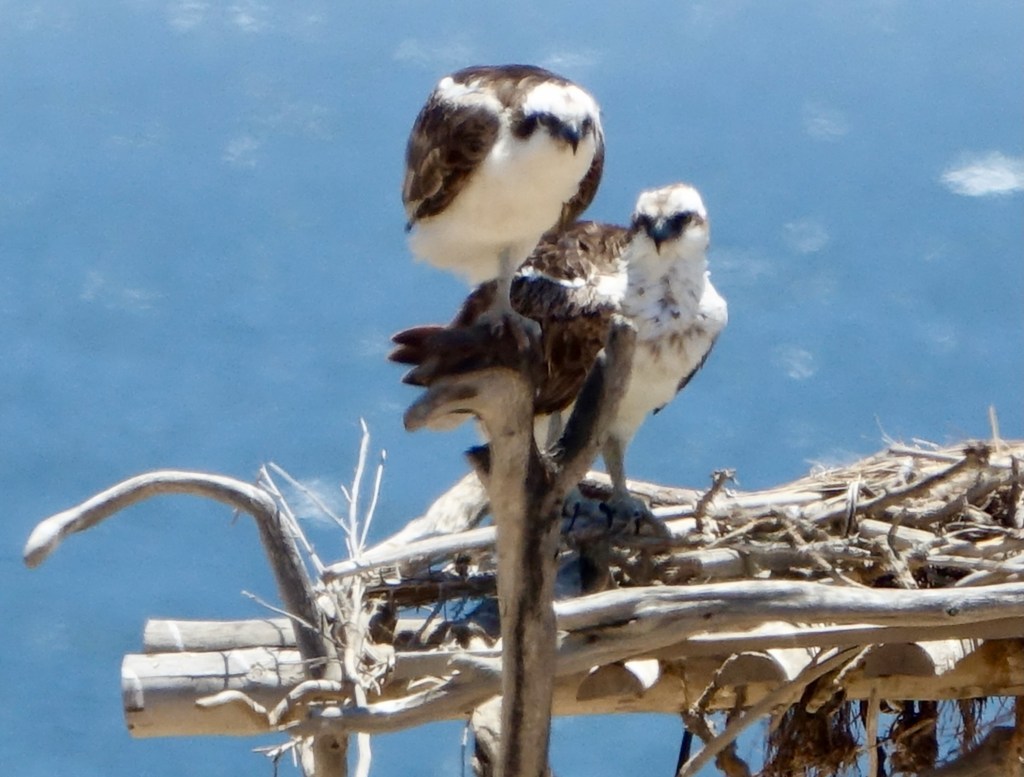
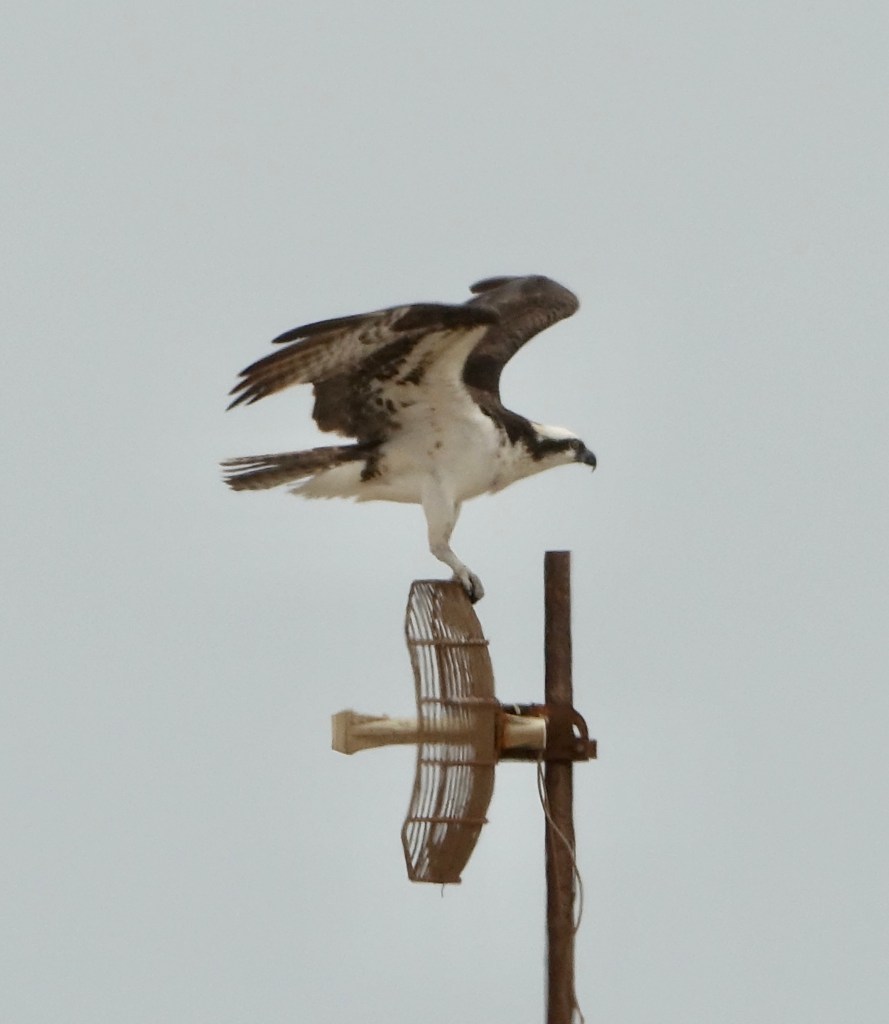
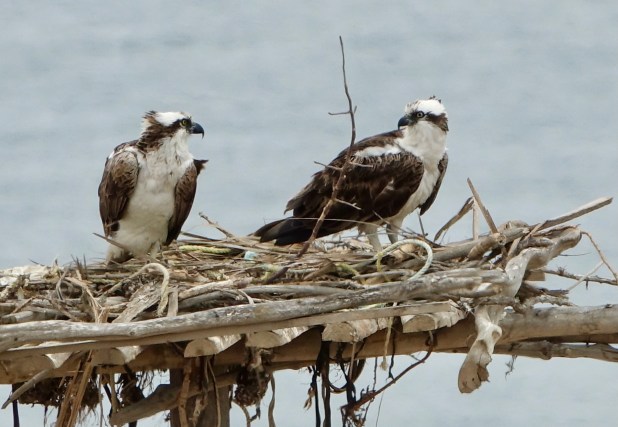
First, they need a new architect. This nest, well, the truth is, they’ve never finished the nest. My guess, and I’m only an observational scientist, is that they are likely two-year old birds, at least the male. He has definitely chosen a nesting site, made an honest attempt to attract a mate, found a willing female, and then wasn’t quite sure what to do next. The photo above is either a look of love, or a look of “I don’t know, do you?”

Second, it’s VERY late in the season for mating. While other nests have hungry chicks demanding constant nutrition, ‘our’ birds (my neighbors deeply involved in what has been a challenging love triangle), come and go, more like dating than mating. Although they do coo (if you can call an osprey call a coo), neck a bit, as in rubbing beaks, and spend some afternoons simply hanging out together.

Male #1, who Ii will give a name, has certainly secured his nesting site. He is present in the mornings, brings his fish breakfast or lunch back to sup on site, and occasionallly adds a stick or piece of seawood to his abode. Afternoons, he’ll call until the female shows up and then they just sit for a while, watching, always alert to the surrounding sounds and activites.

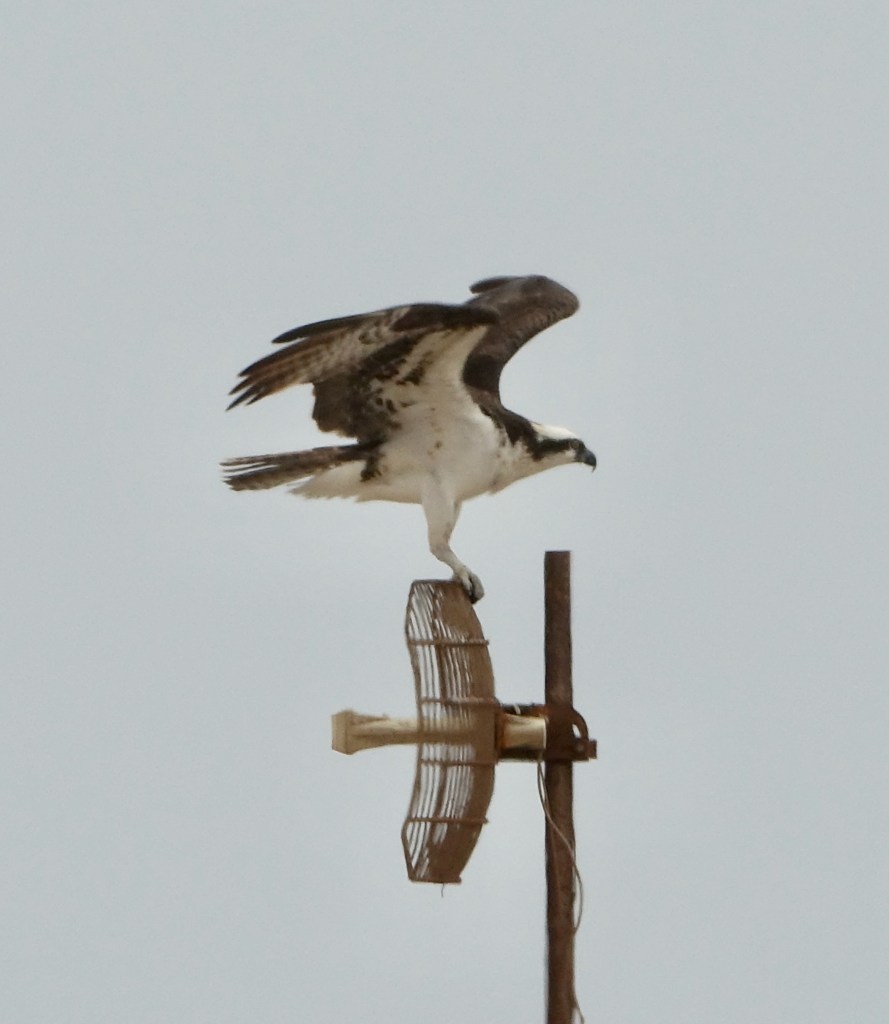
Male #2 continues his attemps to usurp the nest. When the pair is together, he will fly in, swoop down on them, ‘glare’ from the neighbors attention perch above, and do his best to disrupt the romance in progress.

As I type, Male #1 has returned with a fish and is hard at work consuming his lunch. The drama of the love saga and the joy of watching certainly interferes with my other ‘work’, as I can’t seem to stop watching. I love getting to know them, identifying their unique characteristics, and learning their behaviors, all by observation. It’s the best kind of science I can imagine and hugely rewarding.

Osprey Nesting Journey

For two years, the osprey platform remained empty. A gift from my contractor, a wooden platform with a couple of randomly placed sticks perched above a tall phone-pole like wooden stand to attract the sea-hawk raptor. My belief was that the structure had been placed too close to the water, the hunting grounds for all the other waterfowl, too close for any bird in its right mind to choose as a nesting site. At the start of year three, I had it moved farther back on the property, and still, no takers. Plenty of nests in town, huge looming collections of sticks, ropes and gathered seaweed, but my platform remained bereft of bird.

And then, he appeared. A long male who one day arrived with a stick. One stick, and deposited atop the wooden structure. You could probably hear my ‘whoopee’ on the other side of the pueblo. Day after day, for hours, he sat and waited, chirping in hopes of attracting a female. Slowly, he added a few more sticks. Some dried seaweed bulbs. Some green grasses. He’d return to the nest after hunting, large fish in his talons and settle in for his meal. Each time he spied another osprey, his calls rang out across the terrain.

And then, she arrived. A slightly larger-then-he female who perched on the side of the nest-to-be and seemed to be waiting for him to make his move. He flapped his wings. He vocalized. He had her in his sights when another male showed up, and took a position on the neighbor’s weather antennae above the potential nest. Male #1. as I had grown to call him, seemed beside himself, confused as to what was more important. Chase off male #2 or get to creating a marriage with Female #1.

Eventually she grew tired of waiting and flew away. Male #1 was back to solitary. Less time on the nest, but still, but he did add a few more sticks. A bit more seaweed. Lunch and dinner of his catch. Always vocalizing his shrill call whenever another osprey entered the neighborhood.

And now, two weeks after her initial visit, Female #1 has returned. She’s decided to spend more time on the platform. I have yet to see her bring her own nesting materials to what might be her home, but I remain hopeful.

I’ve spent much of early spring fixated on nesting cameras of bald and white eagles across the USA landscape. From Big Bear Mountain in southern California to U.S. Steel in Pennsylvania, a cam in Traverse City, Michigan and elsewhere, the laying of eggs, the hatchlings, the loss of chicklets, an almost consuming watch of eagles has only whetted my appetite for an experience up close and personal on the platform at the edge of property.

Bring on the baby osprey!

’tis the season ….

Wintry sunrises set the tone for southern Baja mornings. By wintry, meaning the early temperatures hover in the mid-50s and I may need to put on a sweatshirt for my walk with Loki. My neighbor, Ernst, without fail, slips into the water for his morning swim. He’ll do this even when the water temps drop into the 60s, somewhere in February.

The nine-days of Mexican Christmas are in full swing, so decorations, pinatas, Christmas carols continue to ring through our city of Loreto, and the tourist season has begun. A wide-ranging palate of foreign tongues – German, Italian, dare i say Canadian? – can be heard on the street and in restaurants. A outward expression of the love for our waterfront location.

Yet even with the arrival of our foreign guests, there is a tranquility, a peaceful quality of life here, that feeds anyone’s need for quiet contemplation. Perfect for greeting the New Year, which is now a mere inhale/exhale away.

The Baja

There’s a magic in this slender peninsula that lies beyond the borders of cities or towns. Beyond the hustle and bustle of commerce and development. That sits on the edge. The untouched. The yet to be disturbed by the heavy hand of man.

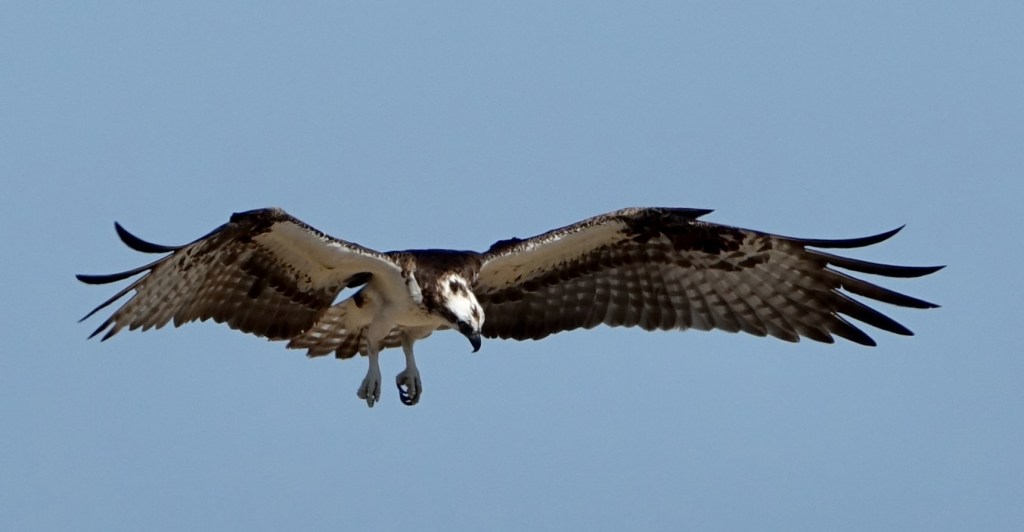
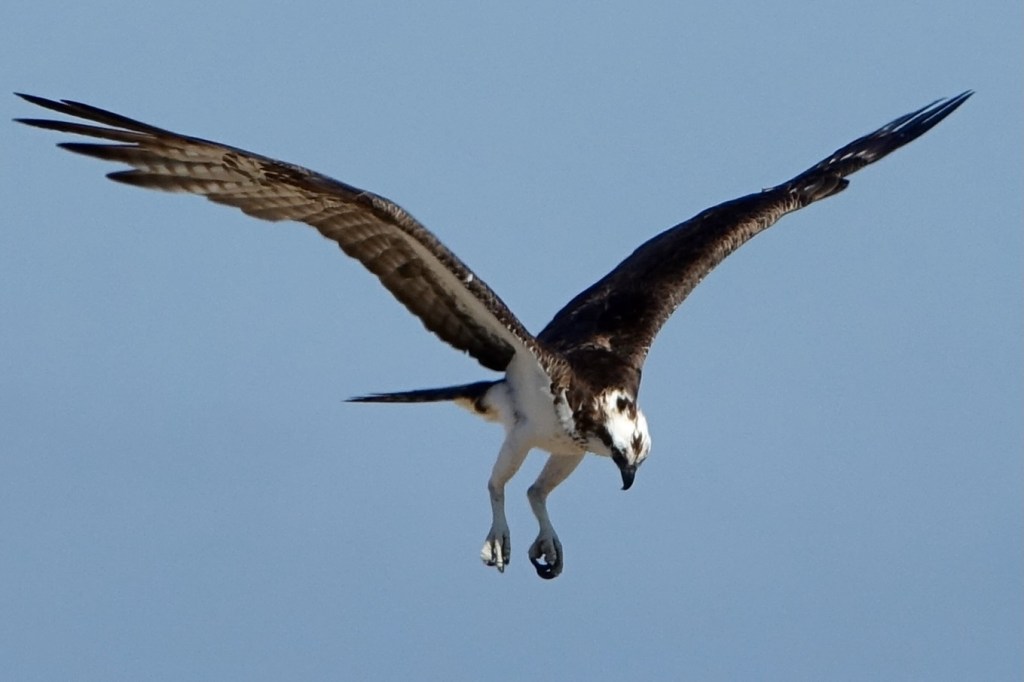
Here, the coyote hunt small prey. Range cattle forage outside of fences. Red-tailed hawks and osprey soar over land and sea, eyes pinned in search of their next meal.

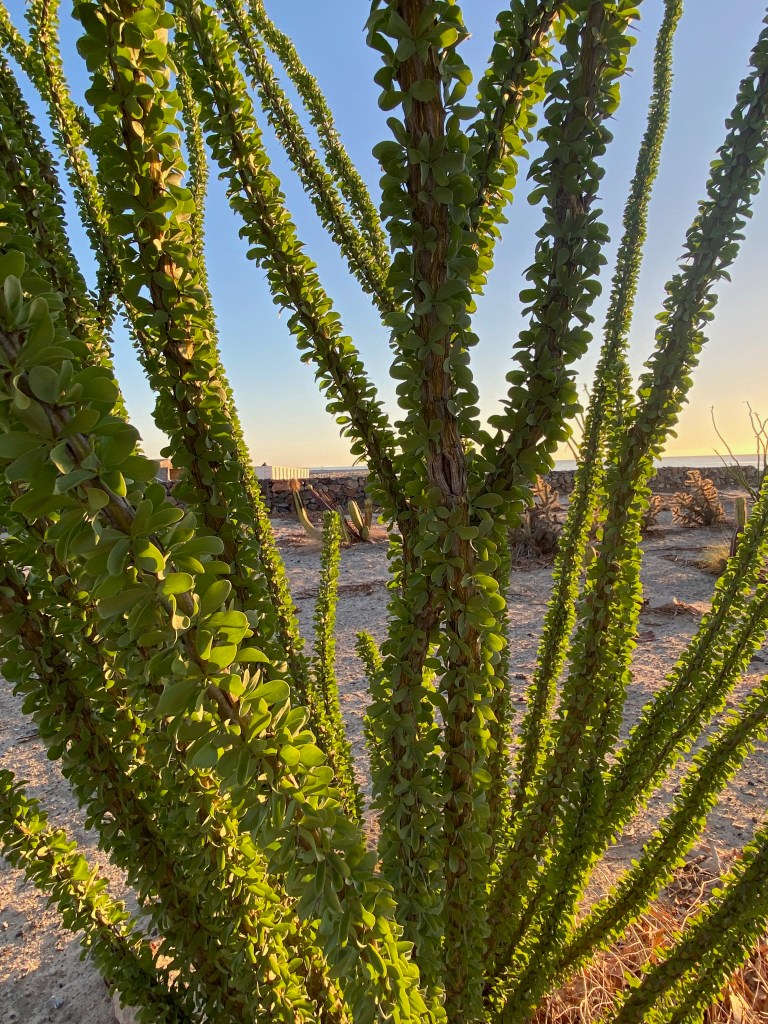
Tall cardon reach their stately trunks every upward, aside paloverde, paloblanco, creosote and straggley cerote. Random water holes, estuaries and narrow canyon pools remind us that water is still the essence, especially in the dry dry desert.

It’s in these lands my soul finds a freedom, a sense of expansion. In the desert, one must look with refined eyes to ferret a tiny flower, a scampering beetle, the tracks of lizard and quail. A roadrunner zooms past. A kingfisher calls from a tree branch. A flotilla of pelicans glide across the face of a wave.

Light from the rising sun reflects in my face. Home in the fierce dry landscape. Home in the magic.

From Above ….

One of the few luxuries of the short flight from Loreto to the States is to view the peninsula from great heights. The rugged expanse of the Baja terrain comes more clearly into focus, with shadows defining its craggy rock faces, narrow canyons, wide arroyos and spiny mountain ranges.

From above, except for the seasonal covering of green, the landscape appears barren – treeless – rough – yet stunning with its angular surfaces met on both sides of its narrow length by water.  On the west coast, the Pacific Ocean.  On the east, the Sea of Cortez. The seas moderate the temperature on the fringe coasts, while in the summer, the central spine steams under the summer sun, and in the winter, chills down to an occasional frost.

In the short expanse of 700 miles, the landscape encompasses arid scrub desert, dry lakes, creeks fed by waterfalls, inactive volcanoes and the piles left behind by their liquid lava activity… visible by highway travel, but from the air, more a palette of smooth surfaces vs jagged edges.

Since I travel both by auto and by plane, I love the opportunity to merge the images in my mind. To track Mex 1 far below from the air and to ponder places where I have camped and kayaked, creates a mind map of the terrain with personal overlays.

This broad and unpopulated expanse of landscape opens my mind and heart and clears the heavy weight of city responsibilities. I am so lucky to call this rugged this country my second home.

sunrise : again

sunrise : october : loreto

stop
inhale the morning

listen
bird chatter and the tumble of beach stones
gull chatter and hammer of woodpecker on palm

feel
moist / dry
desert with a hint of breeze

watch
blue becomes orange becomes red becomes pink
yellow orioles, diving terns, rummaging godwits

night ending
day opening

yes
again

A “One Tide” Day

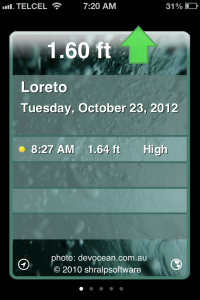
Tide Chart : Loreto, BCS : 23 October 2012

A one tide day? With the low tide last evening before midnight, and the subsequent low tide tomorrow at 12:07am, Loreto will on this day, have only one tide.

How is that possible?

As I’m not an expert on tides, I sourced Oceana, in an attempt to understand this conundrum.

Tides are regular rises and falls in sea level, accompanied by horizontal flows of water, that are caused by gravitational interactions between the Moon, Sun, and Earth. They occur all over the world’s oceans but are most noticeable near coasts. The basic daily pattern of high and low tides is caused by the Moon’s influence on Earth. Variations in the range between high and low tides over a monthly cycle are caused by the combined influence of the Sun and Moon.

Okay – That part is simple. Digging deeper :

High and Low Tides
Although the Moon is usually thought of as orbiting Earth, in fact both bodies orbit around a common center of mass—a point located inside Earth. As Earth and the Moon move around this point, two forces are created at Earth’s surface: a gravitational pull toward the Moon, and an inertial or centrifugal force directed away from the Moon. These forces combine to produce two tidal bulges in Earth’s oceans: one toward the Moon, and the other away from it. As Earth spins on its axis, these bulges sweep over the planet’s surface, producing high and low tides. The cycle repeats every 24 hours 50 minutes (one lunar day) rather than every 24 hours (one solar day), because during each cycle, the Moon moves around a little in its orbit.

Tidal Patterns
If no continents existed and the Moon orbited in Earth’s equatorial plane, the sweeping of the tidal bulges over the oceans would produce two equal daily rises and falls in sea level (a semidiurnal tide) everywhere on Earth. In practice, landmasses interfere with the movement of the tidal bulges, and the Moon’s orbit tilts to the equatorial plane.

Consequently, many parts of the world experience tides that differ from the semi-diurnal pattern. A few have just one high and one low tide per day (called diurnal tides), and many experience high and low tides of unequal size (known as mixed semidiurnal tides). In addition, the tidal range, or difference in sea level between high and low water, varies considerably across the globe.

Monthly Tidal Cycle
In addition to the daily cycle of high and low tides, there is a second, monthly, cycle. In this case, the Sun and Moon combine to drive the cycle. As with the Moon, the interaction between Earth and the Sun causes tidal bulges in Earth’s oceans, though these are smaller than those caused by the Moon. Twice a month, at the times of new and full moon, the Sun, Moon, and Earth are aligned, and the two sets of tidal bulges reinforce each other. The result is spring tides—high tides that are exceptionally high and low tides that are exceptionally low. By contrast, at the times of first- and last-quarter moon, the effects of the Sun and Moon partly cancel out, bringing tides with a smaller range, called neaps.

Okay, neap tide. Alas, the moon is not at it’s last quarter, but “waxing gibbous,” or a moon that is “appears high in the east at sunset. It’s more than half-lighted, but less than full.”

A further web search takes me to discussions of distant places, such as the Gulf of Carpentaria in Australia, where one-tide-per-day are not uncommon – something to do with narrow opening of the bay and water trapped.

Tides, it turns out, are more complex than the simple pull of the moon. A final note from abc.net.au,

Now this special one-tide-a-day thing happens in other places, for exactly the same reason – places like the Gulf of Thailand, the Persian Gulf, the South China Sea and even the Gulf of Mexico. It just so happens that all these places are some of the very best places on Earth for catching fish. I wonder if the once-a-day tides makes the fish all confused, and easier to catch?

It did seem that extra Pangeros headed from the Loreto Marina this morning before sunrise. Maybe there is something to more fish and one tide?

All I really KNOW at this point, is that today, there is one tide – a high of 1.64′ will occur at 8:27 AM, followed by a low of 0.09′ tomorrow morning at 12:07 AM.
When Friends Come to Visit

Cynthia and Cal Wagstaff rolled into Casa de Catalina late Saturday morning.  They’d been making their way down Mex 1 through missing asphalt, torn up roads, water filled arroyos, and detours in the wake of Hurricane Paul.  The drive from Hailey, Idaho is part of their annual re-migration their beautiful casa in San Juanico.  I’d worried about their drive – and was glad to see their smiling faces on arrival.  Chica Bonita and Pancho piled out of the car behind their owners.

Cal wasn’t as convinced that they should stay – he was pretty much about ‘let’s get home,’ but Cynthia prevailed.  We swam, SUPd, laughed, we played with dogs, ate and enjoyed cocktails in the patio.  Love my friends – and all the spontaneity that seems to be what Baja is about.

Morning SUP with Friends

Morning SUP in post-Hurricane Paul waters with Kama Dean and Samuel Young. Paddled down to the Kinninger’s Rancho Jaral to ‘pick them up’ and headed north up the Loreto coastline. Fun to be with friends on a crisp bright morning. Hard to imagine that a mere 36 hours earlier we’d been hunkered down to weather out the storm. The Sea of Cortez – tranquil, if not loaded with lots of floater palms, cactus parts and bits of broken tree trunks.

A small swimming eel-like creature was very attracted to my board – and I thought he might want to hitch-hike, but kept swimming along head up and searching. Identification anyone?