Thanksgiving – 2008

Loreto_ThanksgivingBack in Loreto .. After wild drive down.  Work held us in the states until Thanksgiving morning.  We packed the car the night before, so we were all go.  Only the going was SLOW!  Pouring rain to the border and beyond.

Got pulled over at crossing, but Mexican police only wanted to look briefly in the back, then sent us forward.  Rain kept pouring.  By the time we got to Guerro Negro, we were pooped and the sun was setting.  Decided to call it for the night.

Rose early, drove straight to Loreto, jumped out of the car with the turkey and stuffing prep and started to create a dinner for 14.  Mid-way through cleaning the turkey and the water pump went off.  I threw a few obscenities .. tired and cranky and how can this be?  Then put on my ‘okay, think of it as camping hat’ and parried on.

Steve got the water pump to work.  The turkey was delicious, stuffing, corn pudding, fresh cranberries, asparagus, salad and rolls.  YUM!

Guests included Jaymi, Don, Ariela & Liana Garvett, Bob Lahodny, Dolores and her daughter Paola, Rigo, Leslie & Aram, & Alexander Ogilvie.

Wild Trip to San Juanico and Beyond ..

ROAD TRIP~  with stove, parties, friends & whales.

And I mean – road trip!  Left Laguna mid-morning with overnight in Guerro Negro. Great dinner – as always – at the  Malarrimo Restaurant.  Got up before the sunrise and headed east.  Watched the sun slip over the lip of the Sierra as we dropped down the grade toward Santa Rosalia.

With great luck and no traffic, we pulled into Loreto around 11 AM.  Got the truck unloaded, and on call – Carol’s connection – Richon – arrived to look at the stove and what I need for installation.  No one believed I could get a stove installed in one day.  This IS Mexico. But I was driven and committed.

Val Wilekrson

Val Wilkerson

Barry and Val came by to chat – and stayed 🙂  That’s how it works in Loreto.  Richon brought Juan.  Alexander came over.   Jeanne stopped by and brought her girlfriend, who was fresh from fishing with Chris & the boys.

Steve was deep into rum & cokes until he realized that all the orifices on the stove needed to be converted from natural gas to propane.  Sobered him up (grumpily) fast .. and the job was done.

In the meantime, Jeanne kept saying she wanted to go to sleep and have tomato soup .. but now Steve was grousing about dinner.

Carol & Lee Boyd at Meditarraneo

Carol & Lee Boyd at Meditarraneo

We were supposed to eat at Mediterraneo, Carol & Lee’s excellent restaurant on the Malecón, but now it’s after 8…. and cranky is a good word to throw out. .. So.. with grand and gracious spirit, Jeanne opened her freezer, found ground turkey and a meat loaf was created.

There were potatoes at the house from Boots & his wife Arianna who had been staying while they searched for a place to live.  We mixed russet and sweet for mashed, crafted a salad of cucumbers and tomatoes.. and celebrated a feast.  Alexander had gifted Jeanne a bottle of tequila for her birthday, and this was the time to enjoy.

Wild night and tired, Steve and I crashed down.  Woke early for sunrise and a morning of client work – while we had DSL internet connections.

Catharine Cooper, Dennis Choate, Steve Kawaratani, Bill Clute

Catharine, Dennis, Steve, & Bill

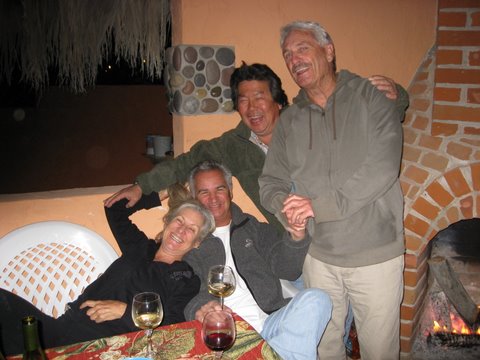
We made an overnight stop in San Juanico where we partied – is there a theme song here? – with old friends and new. We were the guests of Dennis Choate and Donn Stein in their hacienda complex. Donn lent his palapa for the night .. sheets were hastily changed and the party began.

Dennis had good friends, Bill and his daughter, Cathy, staying in his guest house.   Once upon a time, Dennis and Bill had been arch sailing rivals, but now, spinnakers aside, they are best friends.  Dennis builds boats – Transpac and more – at his shop in Long Beach – Dencho Marine.

It might have been the case of wine we brought down for the boys, or maybe it was the fabulous food of the local chefs, but the evening was one of great revelry and memories were created out of deep laughter.

Sailboat racers, surfers, bikers ….. and thank god for the morning after – coffee drinkers.  Bill – you are forever my hero for the espresso!

We all drank too much, ate too much, and laughed harder than we imagined possible.  Dueling iPods provided music and Bill, CC & Steve traded iPhone tricks and info.  I woke up next to my vitamins .. Cathy in her clothes.  Too much fun …………..

Quick check of the surf, not much happeing, and Steve and I jumped back in the Hummer for the drive north along the salt flats to San Ignacio Lagoon.

Whale Kissing & Spy-hopping in Baja

Eye of Baby Grey Whale in San Ignacio Lagoon

Eye of Baby Grey Whale in San Ignacio Lagoon

To be touched by a whale is to be changed for life.

It’s an experience that entered my psyche, bounced around my emotional pool and exited through my intellect. Soft whale skin pressed against my cheek. A throat lifted toward me – “please scratch me.” Mother whales lifted babies toward the boat.

This gift, this play, this sharing.

Can it not be considered an act of love?

How is it possible that these extraordinary leviathans trust us at all? Hunted to near extinction – not once, but twice – their numbers had been reduced to fewer than 100 by human hands hungry for lamp oil.

That they continue to reach out to us, present their young for petting, acknowledge and seek out our presence is a mystery – and some would call, a miracle.
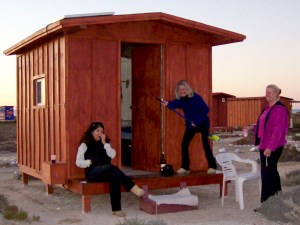
Eloise, CC, Laura at Campo Cortez

Eloise, CC, & Laura at Campo Cortez

We were four – Lynn, Laura, Eloise and me – at Campo Cortez seeking “the friendlies” as the whales in the lagoon have come to be known. To arrive, we’d overcome a faulty car alarm, a dead starter motor, 40 miles of wicked washboard road and one flat tire. Once we arrived at camp, the dusty journey drifted into the past.

Campo Cortez sits on the edge of the lagoon near the boundary of the birthing waters and the playpen in the sanctuary. San Ignacio Lagoon is part of the Vizcaino Desert Biosphere Reserve, a recognized World Heritage site. This desert is extremely dry, consists primarily of volcanic soil and has limited vegetation.

The location of the camps is totally “off the grid.” There is no electricity, no phone lines, or fresh water system.

This has limited the human invasion – no commerce centers or factories mar this retreat. The night sky provides a triple blanket of stars, and the silence is broken only by the whale songs and coyote calls.

On our late afternoon arrival (the tire thing), we were quickly fitted with life jackets by guides Adrianna and Christina, and joined the other “campers” on three separate pongas. The wind was brisk and whipped up small waves and we bounced inside the boat.

Whale spouts surrounded us, and even though we were early in the season, the park personnel had counted 85 whales, all of which seemed to be diving, rolling and breaching in the bay. Our first trip, none advanced to be pet, but they were close enough to almost touch.

That night, we were treated to footage by a film crew from National Geographic, led by documentarian, Luke Inman. He showed clips of whales spy-hopping the boat, spraying the passengers, and being kissed.
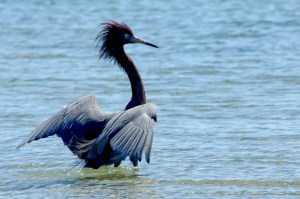
Reddish Heron

Reddish Heron

The tide in the morning was ultra low, and the mud flats in front of our cabins were alive with shorebirds foraging for small crustaceans. Oyster catchers mingled with marbled godwits, sandpipers, heron and cattle egrets. Overhead, two osprey searched the receding water for their breakfast.

After breakfast, we all walked to the point and again boarded the boats. Our boat captain, Cuko, had not driven very far when we encountered our first pair.

He idled the engine and we started to splash in the water. The whales seem to be drawn either to the soft sound or the droplets themselves, but the mother whale came right to the boat with her baby.

We could see them under the water before they surfaced and were all “ooh” and “ahh” as they lifted their heads right next to us to be touched.

Each in turn ran their hands across a skin surface that felt unexpectedly as soft as a chamois. Soon, we had a second pair, and we were petting, scratching – and yes, kissing the tops of these huge mammals heads.

San Ignacio Lagoon Ranger w/Spy-Hopper

San Ignacio Lagoon Ranger w/Spy-Hopper

A park boat nearby whose job it is to insure that no whale watching takes place inside the birthing zone, was surprised by the attention of a solitary whale. She would simply not leave his boat alone, and kept spy-hopping (coming up head first) and peering into his boat. Satisfied that he had no passengers, the whale began to play with the boat, pushing it in circles with her nose, and at one point, lifting the bow gently out of the water.

A sweet four-year old was on our boat, and was simply delighted to watch all the excitement. Over dinner, she asked her mother, “Why do people want to touch them?”

There are probably as many answers as there are those lucky enough to experience a whale’s touch. For me, it was exactly that – the touch. Not simply my hands on their bodies, but their reaching out, soliciting the experience. Together, we bridged the human barrier that separates us from most creatures in the wild.

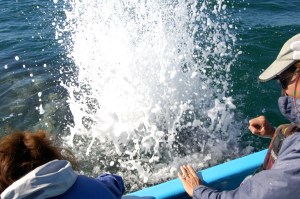
Whale Blow!

Whale Blow!

No longer will the spouts of whale spume offshore be merely white foam. I’ll remember the eye of the whale, how the tiny baby looked up at me from her watery home, and we connected. I’ll be thankful for conservation measures and the way that sometimes, human beings can protect and defend their fellow travelers on planet earth.

Migrating with the Whales to Baja

We’re following the whales, the girls and I, south to San Ignacio Lagoon. After weeks of watching the graceful grays glide past our Southern California coastline, we’ve booked three days at Baja Ecotours outpost in Baja California, on the edge of the lagoon.

Laura McCants spearheaded the idea, and I was quick to spread the invitation. Lynn Brown and Eloise Coopersmith enthusiastically joined the party.

Lynn Brown

Lynn Brown

Laura McCants

Laura McCants

Eloise Coopersmith

Eloise Coopersmith

When the gray whale was first discovered in the North Pacific, it was called the devilfish. Capt. Charles Scammon discovered their major breeding grounds in the lagoons of Baja California. He and his men furiously hunted the whale, and in turn, the grays killed several men and smashed all of his boats. Because of these actions, the grays were feared by the local population.

Luke Inman photographs Grey Whale at Ponga

Luke Inman photographs Grey Whale in San Ignacio Lagoon

It wasn’t until 1977 that the same gray species became responsible for what is now called “the-friendly-whale- phenomenon.” That season, a single gray whale allowed itself to be petted by passengers by all the whale-watching boats it could find.

During successive seasons, the number of petting whales increased, until now. It appears to be learned behavior, and people travel from all parts of the world to be near these gentle giants.

The gray whale has the unique distinction of being the only member of the family Eschrichtiidae, and a mysticete, or a baleen whale. It is a “coastal” whale that migrates from the krill-rich waters of the Artic seas to the birthing grounds in the lagoons of Baja. Their year of travel covers 12,400 miles.

They have streamlined bodies with narrow, tapered heads. The whale received its name from the gray patches and white mottling on its dark skin. Its skin is home to both scattered patches of barnacles and orange whale lice. Newborn calves are dark gray to black, although some may have distinct white markings.

Adult males measure from 45 to 46 feet in length, and females are slightly longer. Both sexes weigh from 30 to 40 tons.

The gray whale has no dorsal (top) fin, but a bump where it would be, and then a series of smaller bumps or “knuckles” that continue along to the tail. Its flippers are paddle-shaped and pointed at the tips; its fluke is about 10-12 feet across, pointed at the tips, and deeply notched in the center.

Gray whales mate in December or January, and a single young is born 13.5 months later — the following January or February. The young travel north with their mothers when they are only 2 months old, and continue nursing until they are 6 to 9 months old. They are generally seen alone or in groups of three.

These whales, which once inhabited both the Atlantic and Pacific oceans, have been close to extinction at least twice in human history, and now live only in the Pacific. Now that they are protected, the gray whale population can continue to recover its numbers.

Eloise, CC & Laura at Campo Cortez

Eloise, CC & Laura at Campo Cortez

“Campo Cortez,” the base camp run by Baja Ecotours, was founded in 1989 by Johnny Friday, an avid diver, explorer and filmographer, and Maldo Fischer, a local fisherman and whale watch guide. Both men share a deep affection and respect for the marine world, and their camp provides eco-conscious travelers with an off-the-beaten path experience. His staff consists of local residents who have a lifetime of knowledge of the area and the lagoon, but are also professional boat captains and naturalists. Their focus is on education and a rewarding experience.

Girls gone wild. Well, not too wild. The camp is solar and wind-powered, and lights are out at 9:30 p.m. That means we’ll have the an increased opportunity for star gazing, hundreds of miles away from annoying city lights. Eloise took a deep breath when she discovered she was “camping,” and friends of Laura’s worried she had set off on a life-threatening experience. Reminds me of the naming of the gray whale — devilfish. How much we don’t know and have yet to learn.

This weekend, we will definitely be in the experiential mode. We are hoping for calm seas and many whale encounters, along with leisurely strolls along empty beaches, and exploratory kayaking in the adjacent mangrove lagoons.

And then there is always the thought that some of the whales we see in the lagoon will be the same that we chance to sight on their journey northward. Maybe we’ll get a tail flap as a confirmation.

Friends, Acquaintances & Chance Encounters

Every trip south I am rewarded with new friends. Seems that Baja just works that way. From casual conversations in the airport to more detailed ‘get-to-know-you’ ones on the actually plane ride, and the chance encounters .. Are there chance encounters?

This trip, a meeting with Johnny Friday, the proprietor of Baja Ecotours, with whom Laura McCants, Lynn Brown, Eloise Coopersmith, and I will journey with in February to San Ignacio Lagoon. We’ll spend three days visiting the migrating grey whales and their young calfs, paddling kayaks in the mangrooves, and getting to know each other better – along with new friends.

Johnny also runs a dive operation out of La Paz – with live-aboard boats. I’ve booked time with him for probably August .. Soccoro Island – whale sharks and manta rays are in my scopes.

The International Conference for Sea Turtle Conservation is held annually in Loreto. At a reception, held at the stunning home of Linda and Tony Kinninger, I was able to spend some time speaking with Wallace J. Nichols, who is with The Ocean Conservancy, and had spent the last year as President of the Turtle Foundation. We spoke a bit about the video script I’ve written .. and the filming of Bill Bahn .. as a conservation educational piece to gather support for Marine Reserve programs in northern California. A popular item with conservationsionists .. a tough sell to commercial fisherman.

Good friend and realtor, Alexander Ogilvie, had been out of town for the party, but he arrived two days later with one of his life long buddies, Gaston. Gaston is a restauranteur in Calgary, Alberta, Canada, and was filled with wonderful stories of life in the north. He also cooks a mean risotto.

Not to be overlooked, the chance meeting of two great guys – Dennis Choate and his friend Donn Stein, who offered up a guest house in San Juanico – if I ever make it to the other side.

Hurricane John

Calle Davis

Calle Davis

Quietly, in warm waters, tragedies are born.  Rapidly rising vapors condense to form clouds which push aside cool air.  Perfect conditions – low sheer, converging winds and hot ocean temperatures – and small spinning vortexes are born.

Such was the beginning of John, a tropical depression born on the west coast of Mexico, who grew from to a category 4 hurricane.  Initially, John bounced along the Pacific Coast of Mexico, pouring rain into the coastal cities as he changed shape and status again and again.  The predicted storm track was toward Cabo San Lucas, then into the cooler water of the Pacific.

Instead, John took direct aim at Cabo San Lucas, and for a while, the press also took aim.  Tourists were bussed to the border.  Hotels and restaurants were evacuated.  John slid close, but instead of coming ashore, he slithered around the east end of the peninsula toward the hotter waters of the Sea of Cortez.

La Paz, the capital of Baja California, was next on the target list, and the press kept some coverage, but with no deaths or major damage, attention moved back to the war on Iraq and the rain spawned by Hurricane Ernesto on North and South Carolinas.

NOAA and others continued to project John crossing the peninsula and exiting to the Pacific.  John, however, had other ideas.

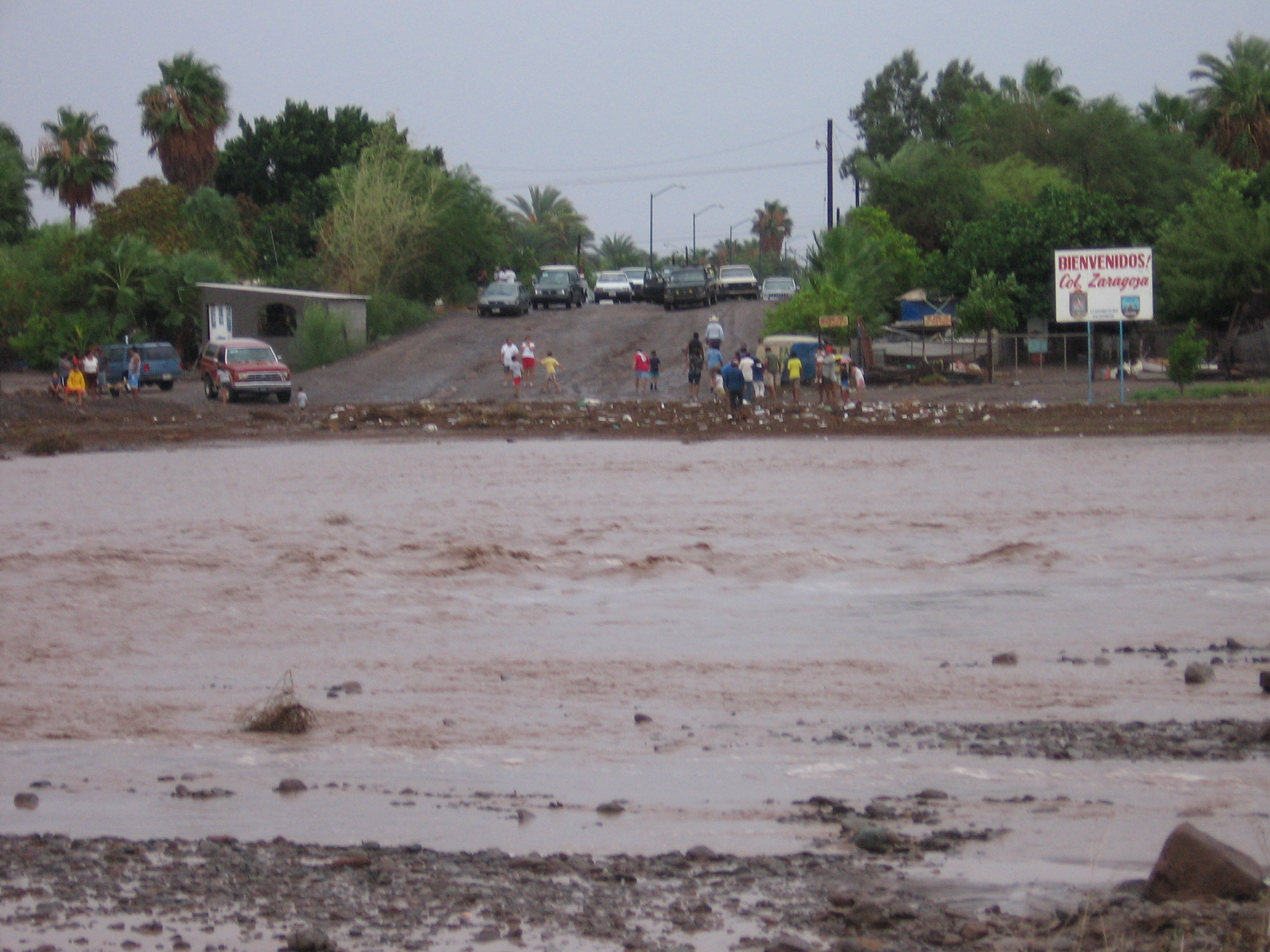
Mex 1 Loreto - Bridge Washout

Mex 1 Loreto - Bridge Washout

Rain and winds pelted the east coast of Baja, taking down roofs and homes in Los Barilles, flooding La Paz, and cutting electricity and phone lines.

The press went home, but John was not done.  He continued to march up the spine of the peninsula, heading toward Loreto, 217 miles north of La Paz.

Loreto’s the location of our second home and that of many good friends. Val and Barry battened down their hatches, while helping secure the front of our property.  We exchanged emails, analyzed every hurricane url available, and prayed for a turn in the storm.  Friends Lynn, Randy, Rosie and Mike raced south to arrive before the storm hit.

John edged onto land, dropping to a category one hurricane, and then a tropical storm.  Winds gusting to 65 kts whipped through Loreto, downing power lines, transformers and cutting off power, water and phones.  Flooding ripped apart streets and arroyos were impassable.

Arroyo Candeleria - Access to Casa de Catalina

Arroyo Candeleria - Access to Casa de Catalina

Communication stopped and worry increased. It was 36 hours after the center of the storm arrived in Loreto and the next time I heard from Val.

When she came back on-line, she reported that all were fine, but that Highway One was closed.  She sent a photograph of the normally dry Loreto River cutting through the highway.

All traffic north and south had stopped, and there were rumors that the road in St. Rosalia to the north was destroyed in many places.

Loreto, while flooded, had suffered minor damage compared to towns to the north.  John “parked” himself in the mountains behind St. Rosalia and dumped his load of rain. Slowly, reports sent via ham radio operators, began to drift in of a horrific story.

The small town of Mulege, population approximately 3100, had taken the brunt of the storm.  The generally tranquil river that flows through the center of town had risen 18’ in 6 hours.  The banks were home to date palms, playgrounds, several trailer parks, restaurants and camping spots.  As the water rose through the night, people were forced to flee their homes with only their shoes (if they had time to put them on).  One American, Peter George Clark, died, when he was swept away inside his trailer.

Roads into Mulege were closed on both sides with arroyos washed out and boulders blocking traffic.  Stunned townspeople with no place to sleep, no water to drink or wash, and no idea where to start wandered the streets.

The first photographs were via a computer powered by a generator in a house on the hill. They showed the total devastation of river level.  No CNN.  No MNBC.  Just townsfolk – trying to make sense of the enormity of the situation.

Cleanup and restoration will not stop at with the first round of emergency services.  Those wishing to help can log on to http://forums.bajanomad.com/  There are several listings within the message threads of ways to provide assistance, from local folks driving trucks, Flying Samaritans, and Rotary Clubs.  It’s a small town, off the radar screen, and even $25 can make a difference.

John ended quietly, just as he had begun, but not over the Pacific as predicted.  John headed inland toward the southwestern United States, where once again, he crossed the radar screen of the media.

Rain to drizzle.  Drizzle to sun filled skies.  The tasks of cleanup, restoration of lives, and rebuilding.

Alegria

dscf0447.jpgAlegría is a 1972 “Ghost Boat” manufactured by Janus in Inglewood, CA. She is hull #433 – 13’1″ long .. and CF 0711 TL. A birthday present from Steve, she is already a seasoned Sea of Cortez sailor. In fact, I’m sure she knows more about the waters than I do, but that simply means that she can be my teacher.
Stepping the MastWe’ve had a couple of fun ‘get to know her’ runs. The last one with a strong out-going wind that died down flat. I kept working the tiller to get closer to some tiny puffs. Found a good little on-stream blower that took me back to the mooring. I was so proud that I’d made a perfect landing .. only to have the buoy pull off in my hands. The chain – a good 9 years old, had worn through on the bottom. Time for a new mooring!

Cooper’s First Visit

Cooper in Loreto

Cooper in Loreto

Cooper arrived via Hummer with Stephen in the early weeks of October, 06.  He had a list of never do’s .. that quickly fell by the wayside.  One, was kayaking .. and he did hold out for a solid five days.  But once he found ‘his’ boat .. the new white Cobra .. he was a man with a mission.  A paddling mission.

Cooper & Steve assembling boat

Cooper & Steve assembling boat