Sister Cityhood Official!

ddc2f8f1-7dce-4b44-b496-304cbb8c266d On Monday, March 30, 2015, President Jorge Alberto Avilés Pérez of Loreto, Baja California Sur, received the “Keys to the City” of Ventura, California from Mayor Cheryl Heitmann, confirming the Sister City relationship between the two municipalities.  The formal ceremony, which took place in the historic Ventura City Hall, included the reading of a proclamation, declaring the relationship between The City of San Buenaventura, California and The City of Loreto, Baja California Sur, “To encourage bi-national promotion of conservation, education, social entrepreneurship and cultural exchange between its citizens and governments in support of the Parque Nacional Bahía de Loreto and Channel Islands Sister Park Project.”

President Avilés thanked the people of the City of Ventura for the distinction of Sisterhood with the City of Loreto.  In a short speech, President Avilés remarked that, “Ventura and Loreto are two cities that have in common historical and geographical perspective and the mutual desire to develop appropriate strategies to support conservation and restoration of biodiversity in the respective territories and to continue to work for the mutual good of our sister cities.”

This solidified relationship provides the opportunity, “to work in coordination with the institutions concerned to protect and conserve our environment,” continued Sr. Avilés.  The Sister City connection furthers a move toward confirmation of Sister Park/Sister Reserve between the Channel Islands National Park and The Bay of Loreto National Park.

Eco-Alianza de Loreto, A.C. spearheaded the possibilities of the Park inter-relationship, as well as Sister City status, and has served both as facilitator and coordinator of the programs in a close working relationship with the Channel Islands National Park and the City of Ventura.  When completed, the Sister Park/Reserve relationship will provide for the exchange of best-science practices, park resource management and enhanced Sister City economies associated with eco-tourism programs including unique cultural exchanges.

President Avilés was accompanied by his wife Mrs. Nancy Saldaña Cuevas, Tony and Linda Kinninger co-founders with Hugo Quintero Maldonado of Eco-Alianza, Marla Daily and Kirk Connally, of Santa Cruz Island Foundation and Terra Marine Research & Education, Inc., and Norma Garcia, the  representative of the Loreto Sister Cities committee and a member of the Board of Directors of Eco-Alianza.

The day after the ceremonies, Mayor Heitmann and the contingency from Loreto enjoyed a boat tour to Santa Cruz Island, hosted by Island Packers, where they routed the University of California Research Field Station facilities with an inland Jeep tour.  Following lunch, the group boarded a small plane for an aerial tour of the Channel Islands and a flight back to the Camarillo airport.  That following evening, the Sister Cities committees met at City Hall to begin planning first steps.  Mayor Heitmann lead the meeting with introductions, short presentations and a Q & A for all those attending.

Eco-Alianza would like to thank all those involved for making this first step both a success and a reality.  Special thanks goes to Russell Galipeau, Superintendent of the Channel islands National Park, Kate Faulkner, Chief, Natural Resources Management, CINP, Yvonne Menard, Chief of Interpretation, CINP, and most especially to Mayor Cheryl Heitmann for organizing this first meeting of the Sister Cities and for making the Loreto delegation feel so welcome in their beautiful city.  We look forward with great anticipation to the benefits of the Sister City relationship that is key to both the proposed Channel Islands National Park and Parque Nacional de Loreto Sister Park status.

For more photos:  http://us7.campaign-archive2.com/?u=3944dc3c25cd857ae00391bf1&id=2b15e7c8e4

Mining in Baja California: Is it Worth the Risk?

Two presentations by

Mark Spalding, President, The Ocean Foundation

Mining Concessions in Baja California

Mining Concessions in Baja California

Please join Mark Spalding on Friday, April 10, at 3pm at the indoor restaurant at the Inn at Loreto Bay, or on Saturday, April 11, at 5pm at the Community Center for the Environment (CenCoMA) at Eco-Alianza headquarters for an informative presentation and discussion regarding his ongoing research on the various mining projects throughout Baja California Sur, including Loreto.

Is mining actually good for the economy for more than the short term? Or does it do more harm to long-term sustainability of natural resources (land, water and sea) and the plants, animals and people who depend on them? What does it mean for the tourism sector?
Three major projects are currently in various stages of development:

  1. Loreto/San Basilio: Azure Minerals Limited is an Australian mineral exploration company focused on developing mining projects in the richly mineralized Sierra Madre Occidental mining province in northern Mexico. In 2013, Azure successfully bid for the Loreto Copper Project, which covers 9,571 hectares on the east of the Baja California peninsula, 6 kilometers north of the town of Loreto.
    Todos Santos: Los Cardones is proposed open pit metallic mining project. The EIA for the project predicts that Los Cardones will occupy 543 hectares and will include two massive open pits from which 173 million tons of material will be extracted. 135 million tons of extracted material will be placed in material banks of waste rock and 38 million tons of the contaminated processes material will fill a massive tailings pond. The project will require the construction of a desalination plan on the Pacific coast near as Playitas that will extract 7500 cubic meters of water per day.
  2. Ulloa Bay (between San Carlos and Abreojos): Exploraciones Oceánicas a Mexican subsidiary of Odyssey Marine Exploration (OMEX)is in the permit process for underwater mining for phosphates in Baja’s Pacific coast. Known as the “Don Diego project” Ocenanica has received it’s concession for the Gulf of Ulloa but does not yet have its permits. The Environmental Impact Assessment (EIA) for proposed dredging and recovery of phosphate sands from the “Don Diego” deposit has been filed with the Mexican Secretary of Environment and Natural Resources (SEMARNAT) as of Sept. 4th, 2014.

Mark is President of The Ocean Foundation in Washington, D.C., and a Senior Fellow at the Middlebury Institute of International Studies, Center for the Blue Economy. He is an environmental expert and attorney, tirelessly advocating on behalf of the world’s coasts and ocean. Mark has engaged in numerous environmental challenges in BCS, including last year’s successful challenge to the Cabo Pulmo development, and the successful prevention of a second industrial saltworks at Laguna San Ignacio. Mark also has a particular affinity for Loreto, serving as a member of Eco-Alianza’s advisory board since its founding, and having helped to establish and steer the Loreto Bay Foundation.

There are two separate opportunities to learn more about mining and associated risks in Baja California Sur with Mark Spalding, President of The Ocean Foundation. Come and increase your knowledge about environmental concerns and add your voice to the conversation.

Friday, April 10, 3pm

The Inn at Loreto Bay
Indoor Restaurant
Loreto Bay
Saturday, April 11, 5pm

The Community Center for the Environment
Eco-Alianza Headquarters (CenCoMA)
#3 Miguel Hidalgo esq. Romanita
Col. Centro

The Track of Hurricane Odile

Horricane Odile's Track up  the Spine of Baja

Horricane Odile’s Track up the Spine of Baja

I am a storm watcher/lover .. but this one, Odile, may be hard to love. While I’ve been stateside for the duration, my heart and energies have been focused on Baja – the long skinny peninsula that is my second home.

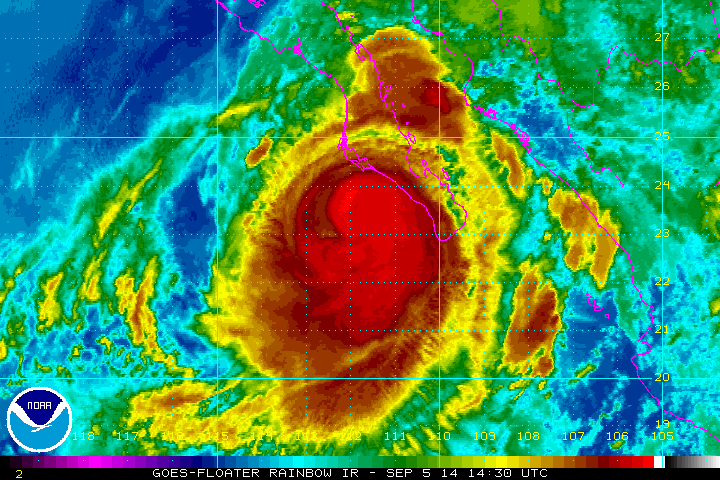
Odile – as you can see from the graphic – drove straight up the spine of Baja and has been called ‘the most powerful hurricane to ever hit Baja’. Her track was unusual – the bulk of her interaction with land was on top of land, not at sea. She maintained hurricane status for the bulk of her journey. The desert cannot absorb rain when it comes too hard and too fast, and rushes down canyons and flashes out arroyos to the sea. And then there was the wind …

Power is out. Phones are down. The early photographs of Cabo show horrible damages – and to a city that has a very substantial infrastructure and in new construction, modern building codes. The rest of the Baja – maybe not so.

It’s horrible not knowing what happened to my neighbors and the town. One video shot from the top of the Mission Hotel shows waves breaking on to of the malecon. I can only imagine that the streetfront businesses had minor to major flooding.

A brief cell phone call late yesterday afternoon from my next door neighbor – how it got through I have no idea – said that her house was totally flooded from the horizontal rain – that she’d gone through all the towels – wrung them out – and the water was still coming in. Her fans had been ripped off – and then she had to go. No power to recharge her one lifeline to the outside world.

Loreto was hard hit – that’s obvious from the storm track and early reports before power was cut. But Loreto, too, has a decent infrastructure – and some of the most resilient people I have ever known. All of Baja for that matter. Shovels, mops, bulldozers will be hard at work before the rain drizzles have stopped.

The most pressing issue will be the roads and flash flooding that Odile has likely caused. Mex One is the lifeblood of the peninsula and trucking of supplies has the one route north and south. Unlike the states, when the roads was out, everyone that is able jumps into help. Tractors tow semi-trucks through washing and mud-laden arroyos. Boulders get moved off the road. New paths are created around obstacles. There is no shutting down the highway for months while surveyors decide what to do and budgets have to be settled and contracts awarded. Nope. Just get on with getting on and move people and goods. Detailed repairs will happen later.

This morning, all prayers to those who lost homes, autos – whatever Odile threw at them. And hopes that hands together, a speedy recovery can be made.

And then .. there is the next storm.  Really? Polo? Please please head west …….

None of the forecasts look good …

Hurricane Odile set to make landfall / Cat 3 Storm

Hurricane Odile set to make landfall / Cat 3 Storm

With Odile just miles from Cabo San Lucas, winds and rain blast their way across the region. 22 airlines canceled flights in and out of city. Evacuations of up to 30,000 people are possible. Forecast is for up to 18″ of rain – okay – that’s a LOT OF RAIN!!! And sustained winds at around 135 mph. The imagery looks as if the storm is swallowing the Baja.

Seriously – Another Hurricane?

Hurricane Odile - Cat 4

Hurricane Odile – Cat 4

“Odile” is the latest in a string of late-season hurricanes with similar paths – off the west coast of Baja. But each one seems to have been moving slightly closer to land – and Odile looks as he he’ll skim the coastline, wreaking havoc with winds and rain. On Sunday morning, the storm has already intensified to a Category 4 – a “major and dangerous hurricane” – with sustained winds at 135mph and gusts up to 160mph. Batten the hatches. Put up the storm shutters and bring all the patio furniture inside.

Even in their fury, the storms seen from satellite are mesmerizing.

After the storm ….

Sultry .. the air thick with moisture but still. No wind ruffles the palm fronds. Splashing fish jar the glassy sea surface and small shorebirds call to one another in their morning search for food. Golden sun drives trails across the water, free from her stormy yesterdays. A low bank of clouds hangs over Isla Carmen’s craggy shape. At the water’s edge, tiny rolling bumps curl and roll into sand and stone. The passing of the storm .. the beginning of a new day.

Sunday dawn .. after the storm

Sunday dawn .. after the storm

Hurricane Norbert – September, 2014

I admit it .. I’m a storm junkie. Something about the drop in barometric pressure and the wildness in the skies. I became edgy. Can’t sit still or focus. Pace the perimeter. Waiting. Watching the sky. Watching satellite photos and charts. Norbert was to be small .. A category 1 storm for a short time and then a tropical depression. He fooled us all by building to a Category 3 – but all of it off the west coast of Baja – and with no serious impact.  We had 3″ of rain in Loreto and an amazing 49mph gust.  I was awakened at 3am by what sounded like a bucket of water thrown at the window.  Palm fronds bent agains the weight of the wind.  The normally placid Sea of Cortez whipped to a wind-chopped frenzy.  A wild alertness that accompanies a storm.  Yes, a junkie – particularly when they have some punch but no destruction.

rb0-lalo
The storm sent clouds north from south and west of Cabo San Lucas on the afternoon of the 4th. By dawn (okay it was dark with no real sunrise) the storm had moved up the peninsula and after the 3am slam, rain and winds began to affect Loreto. By 3pm, the skies had opened, the wind had laid low the palm trees and ‘game on’ – the storm raged through and into the dark of night. Morning, the 6th, still dark skies, but by afternoon – clearing skies. Then sunset, an arm of the storm – now directly west of Loreto – laid a thick band of grey which intermittently spit water. Seas calm. Storm now a memory. We wait for the next circular disturbance.

Thoughts from Mark Spalding & The Ocean Foundation

World Oceans Day: A Chance to Remember Complex Connections

By Mark J. Spalding, President, The Ocean Foundation

In advance of my most recent trip to Mexico, I had the good fortune to participate with other ocean-minded colleagues, including TOF Board member Samantha Campbell, in an “Ocean Big Think” solutions brainstorming workshop at the X-Prize Foundation in Los Angeles.  Many good things happened that day but one of them was the encouragement by our facilitators to focus on those solutions that touch the most ocean threats, rather than address a single problem.

This is an interesting frame because it helps everyone think about the interconnectedness of different elements in our world—air, water, land, and communities of people, animals, and plants—and how we can best help them all be healthy.  And when one is thinking about how to address the big threats to the ocean, it helps to bring it down to the community level—and thinking about ocean values being replicated over and over gain in our coastal communities, and good ways to promote multi-pronged solutions.

Ten years ago, The Ocean Foundation was founded to create a global community for ocean conservation minded people.  Over time, we have had the good fortune to build a community of advisors, donors, project managers, and other friends who care about the ocean everywhere.  And there have been dozens of different kinds of approaches to improving the human relationship with the ocean so that it can continue to provide the air we breathe

Vet in Loreto

I went from that Los Angeles meeting down to Loreto, the oldest Spanish settlement in Baja California.  As I revisited some of the projects we funded directly and through our Loreto Bay Foundation, I was reminded of just how diverse those approaches can be—and how it is hard to anticipate what might be needed in a community.  One program that continues to thrive is the clinic that provides neutering (and other health) services for cats and dogs—reducing the number of strays (and thus disease, negative interactions, etc.), and in turn, the runoff of waste to the sea, predation on birds and other small animals, and other effects of overpopulation.

Mangroves Planted by TOF

Another project repaired one shade structure and added an additional smaller structure for a school so that children could play outside at any time.  And, as part of our effort to make already permitted development more sustainable, I was pleased to see that the mangroves we helped plant remain in place in Nopolo, south of the old historic town.

Yard Sale at EcoAllianza

Still another project helped Eco-Alianza on whose advisory Board I am proud to sit.  Eco-Alianza is an organization that focuses on the health of Loreto Bay and the beautiful national marine park that lies within. Its activities—even the yard sale that was happening the morning I arrived to visit—are all part of connecting the communities of Loreto Bay to the incredible natural resources on which it depends, and which so delight the fishermen, tourists, and other visitors.  In a former house, they have built a simple but well-designed facility where they conduct classes for 8-12 year olds, test water samples, host evening programs, and convene local leadership.

Loreto is just one small fishing community in the Gulf of California, just one body of water in our global ocean.  But as global as it is, World Oceans Day is as much about these small efforts to improve coastal communities, to educate about the rich diversity of life in the adjacent marine waters and the need to manage it well, and to connect the health of the community to the health of the oceans.  Here at The Ocean Foundation, we are ready for you to tell us what you would like to do for the oceans.

IMGP0011

Always Dreaming …

Even when I’m not in Baja, I dream of her. The starkness and beauty of her deserts. The rugged cliffs of her mountain ranges. The two faces of her seas – the Pacific Ocean and the Sea of Cortez. Blessed with a 2 hour reach of either side, I can trade surfboard for SUP board – cold fish for warm fish – crashing waves for serene waters.

Last evening, I paddled the Sea of Cortez and was rewarded with leaping fish and soaring birds. Here’s a small sampling: