.. and not necessarily Clinton, although by now everybody has to be thinking that she would have done a much better job …
But not politics – storm surf – and on the horizon looks like some big time fun for southern Baja.
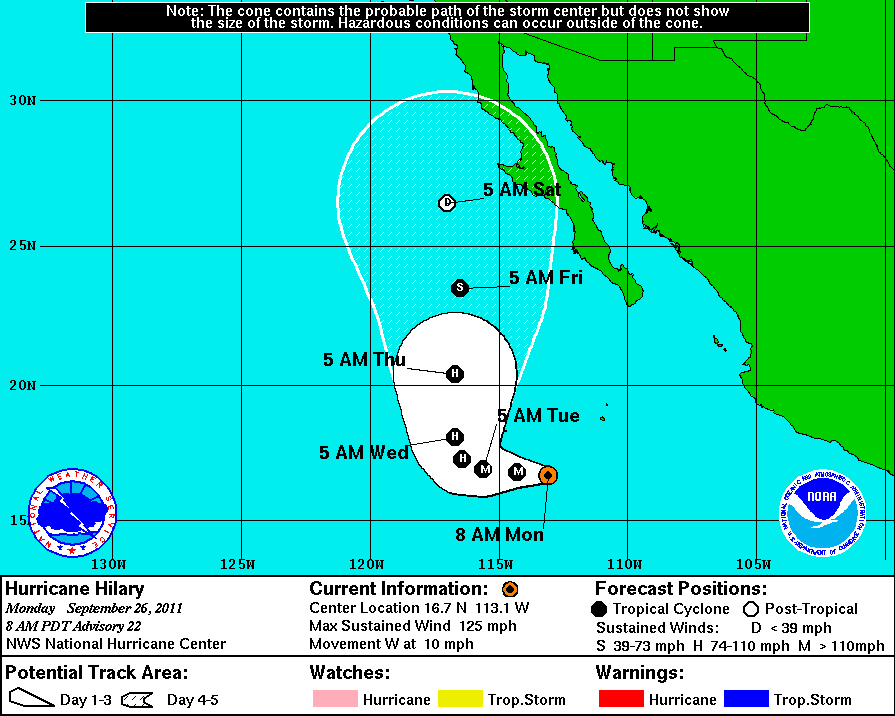
Hurricane Hilary appears on track to leave most of Baja alone – unless she turns north early. In which case, winds and heavy rains could batter portions of Baja that have seen no significant rain in over a year. Surf won’t be particularly wonderful – onshore winds and tight spacing between swells … Oh, those magical powerful forces of nature that we have only the power to observe.
Gads .. Have I really been ‘north’ for over two months? A 10 day road trip turned into 5 weeks! Guess I was having a good time 🙂
Started out in Virginia City at the Cobb Mansion, owned by Jeff & Paul (buddies from Loreto). Friend Carol (used to be from Loreto) flew in from her new home in Austin and we partied and took in the sights for four days. Met new friends, got to hang out with Lacy J. Dalton, and wandered around Virginia City.
Next stop : Idaho. My sister Claudia lives in Bellevue, and friend Cynthia (from San Juanico) has a summer home in Hailey. Buster got reunited with his Baja dog buddies, Pancho and Chica, and Cynthia I had some fine hikes in the Sun Valley area. Even took in an outdoor symphony!
Claudia and husband Jimmy kept saying ‘stay’ .. so I did. Jimmy took us flying, Claudia and I floated Silver Creek in their canoe, we took the canoe up to Petit Lake and paddled in ferocious winds (reminder : Jimmy : get another lightweight paddle!), took more dog walks, and then took the big boat out to Magic Reservoir and fished, swam, lunched and laughed. Alan, from Laguna Beach, showed up in his RV with his kids in the midst of their summer drive. He and daughter, Lili, joined Claudia, Denise (a Laguna Beach girl from way back) at Z – a sushi spot that has killer rolls.
It was hard to leave sunny Idaho – but I had a bug to go and visit Lila and Diedre in Bandon, and Buster and I took off on small roads, large roads, any roads .. exploring the eastern section of Oregon. Beautiful country. We stayed in Bend, drove to and sort of around Crater Lake, and on to the Oregon Coast.
Since I hadn’t planned on Oregon, I’d left surfboards, paddleboards and wetsuits at home. BIG MISTAKE! There was surf, rivers to paddle and just good fun that next trip, I’ll be sure to be better prepared.
In Bandon, I ran into Norm, who spends his winter’s kite surfing and/or surfing surfing in Baja. Such fun to see friends I know from Mex in out of the way corners of the USA.
I missed ‘home’ .. I didn’t miss the overwhelming heat that blanked the peninsula this summer. There was one day when the heat index was 135°. Okay, that might not be quite human!
Glad to be heading south this week. Can’t wait for whatever surprises wait for me. Time to touch that magical Sea of Cortez.
The waters around Loreto are usually pefect for SUPing – Stand Up Paddling. This morning was no exception. I took off on my fish – a 9’6″ Waterman – and headed up the coast toward Coronado Island. Winds were light and building, with lots of opportunities to refine my balance as wind driven waves crashed over the nose of the board.
Each stroke, a moment of zen. A moving water meditation.
Morning delights:
Baby yellowtail chased by baby dorado.
Leaping spinning manta rays.
Translucent blue flying fish chased by baby yellowtail.
Magnificent frigate birds gliding overhead.
A floating crab. What was he doing so far from shore and/or on the surface?
Clam divers dragging innertubes – with seagull hitchhikers on board.
Bluefoot and brown boobies diving and gliding in search of fish.
Vultures on-shore, finishing off discarded fish carcasses.
Children on the beach, playing in the the shallows.
Horseback riders out for an early ride.
Dogs running and chasing sticks.
Boats speeding to and from Coronado and fishing spots.
A great two hour paddle floating on turquoise/cerulean waters, surrounded by offshore islands and the ridgeline of the Sierra Gigantica. A perfect morning ……..
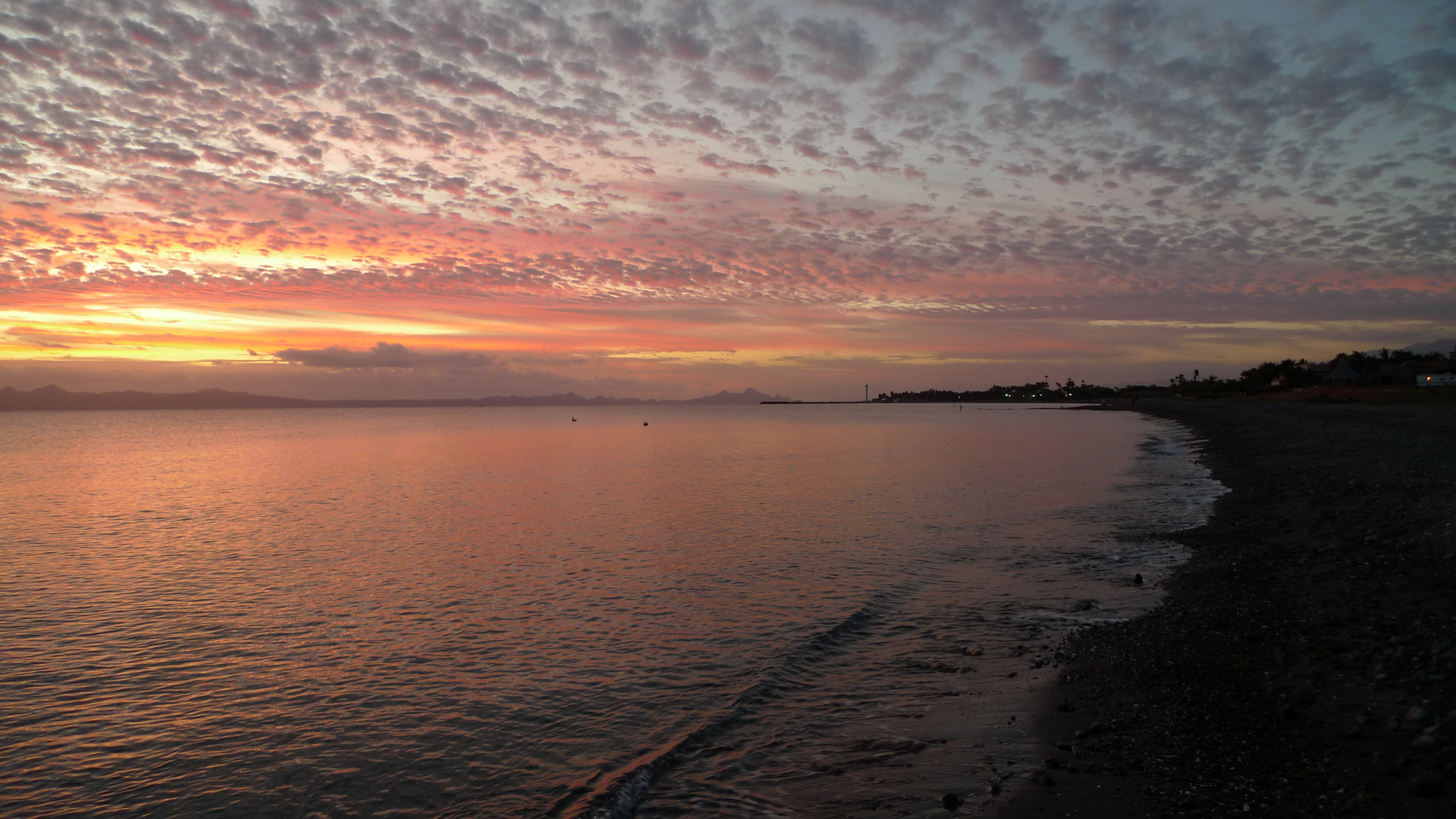
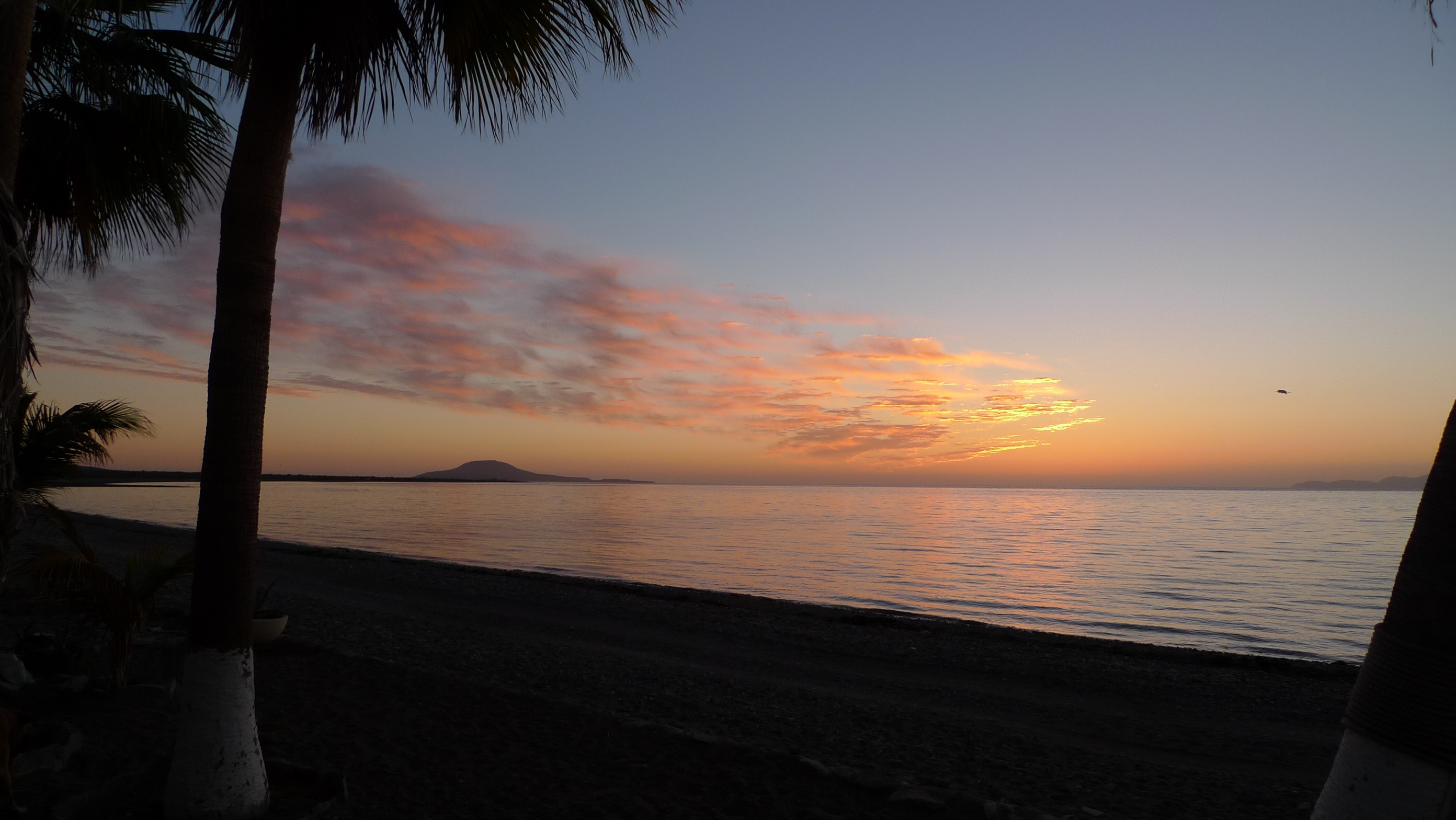
I inhale the steamy morning air, listen as ripples splash against the beach stones … coffee in-hand, the sun slithers up behind the clouds and once again, the day begins.
The pure elegance and simplicity of the dawn do little to assuage the raging that fills the United States over a budget crisis that no on seems to understand or have grip on. Everyone pontificates, shores up their positions … protects their own private interests.
But forgive me .. no, don’t. This comes on the heels of several decades of ‘greed-building’ .. where the dollar (euro/whatever) has become more important than anything else. We are surely in trouble ……………
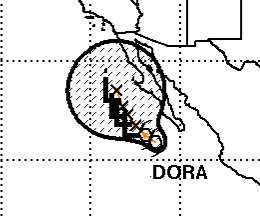
No doubt, everyone is glad that Hurricane Dora went from Cat 4 to a tropical depression in the blink of an eye, along with moving broadly westward way from the coast. While we’d all like some rain, no one emraces the potential destruction of a hurricane.
This evening, long tendrils of Dora’s arms reached across the peninsula into the bay of Loreto. Winds continue to froth the sea’s surface and bend the palm fronds downward. The breezes have lowered the temperatures – at least for a while – and the dogs and I celebrated with a short beach walk.
Stateside for work, which is bountiful, and for which I am extremely grateful – but the press of the City takes its toll. Sooo many cars, too much traffic. Everyone is in a wild hurry to get ‘there’ .. and I think, rarely appreciates where they actually ‘are.’
“Things” matter a lot here : clothes, cars, trends, electronics. Without even pondering, I find myself drawn back into the fold. “I need” … a long list manifests. But do I? What do any of us really need to live on? And does any of the stuff with which we overload our lives make us happy?
In Mexico, I ‘lean’ it back, live with less ..spend more time expressing my creative talents to manifest a this or a that.
And then there is the water. Warming and warmer. The color of the sky mixed with turquoise. A salinity in the Sea of Cortez that is higher/different than that in the states. Uncrowded … a morning paddle of many miles surrounded only by the sea, the edge of mountains, the off shore islands and a dolphin or two. The way the water wraps herself around my skin… the way I am able to merge with her beauty.
Yes .. past time to head south again ….
Not only can my good friend Jimmy surf, but he’s one hell of a cook – excuse me – make that chef. Notice the title with his name. For more information on his skill set, and his killer MOJO product line, click here : http://www.chefjimmy.com/
‘The last fallen mahogany would lie perceptibly on the landscape, and the last black rhino would be obvious in its loneliness, but a marine species may disappear beneath the waves unobserved and the sea would seem to roll on the same as always.”
– G. Carleton Ray in “Biodiversity”, National Academy Press, 1988
Last week I had the honor of attending the Conservation Science Symposium in Loreto, BCS, sponsored The Ocean Foundation and a consortium of charitable organizations. Researchers, scientists, and resource managers from both the United States and Mexico, joined with local community members in a dialog about conservation in the Gulf of California and Baja.
For the most part, Baja California is a rugged and arid desert region with mountain ranges that separate the Pacific Coast from the eastern Sea of Cortez. There are small eco-systems within the overall peninsula that affect fisheries, agriculture, and the availability of water.
The symposium was broken into multiple tracks with presentations ranging from “Protected Areas and Biodiversity” to “Species of Concern.” Overarching was a discussion of community involvement, government interaction, and how to manage conservation for the most effective outcomes, both to habitat and to human populations.
The conversations were lively. Everyone is a stake holder – whether a developer who wants to grade down a mountain for a real estate development (and disrupt and/or destroy a watershed in the process) or a fishermen, whose entire livelihood is based on the bounty of the sea. In many ways, it is only now, in this age of rapid and constant information exchange, that we become increasingly aware of the effects of our actions and activities.
In the northern Gulf of California, there is small dolphin, the Vaquita, which has been seen by very few human beings. It is the smallest – less than 5’ long, with calves the size of a loaf of bread – and rarest cetacean on earth. It is estimated that less than 200 remain. When they are seen, they are tangled in the shrimp fishermen’s gillnets and drowned – adults, juveniles, and newborns.
Vaquita, or “The Desert Porpoise,” came into a small spotlight after a 2006 expedition led by Bob Pitman to search for the Baji dolphin on the Yangtze River in China. After two months of searching, not one dolphin was spotted, nor had the local population seen any. The Baji had become extinct because of human population expansion and related activities. Extinct: as in no more, never again, gone forever.
The situation in the upper regions of the Gulf of California is similar to that of China. The men who fish the region know no other trade, nor are there opportunities for change. They do what they know how to do to feed their families, and in most instances, live a subsistence existence. How to convince a man who needs to eat, that his activities, which are killing off a small sea mammal, need to be changed?
Several approaches have been developed and are being tried simultaneously. Education about the plight of the Vaquita is a keystone.
A protected zone – a no-take area – was established with the northern waters around the known Vaquita habitat. Alternatives to gillnet fishing are being explored. The Mexican government, along with several NGOs, developed a plan that either bought out fishing permits or ‘rented’ them.
If all the programs fail, then the Vaquita – like the Baji – will no longer swim in the Sea of Cortez.
It did not go unnoticed by the attendees at the Conservation Symposium that the US administration voted not to list the Bluefin Tuna as an endangered species. The rationale was that no one could prove, that without protection, that the tuna would disappear.
There were cheers from the fishing industry, where one Bluefin can sell in the Japanese market for up to $400,000. There were wails from those whose research has followed the majestic tuna’s decline. Between 1970 and 1992 the eastern Atlantic’s stocks declined by 80 percent; the western stocks by more than 70%.
The National Oceanic and Atmospheric Administration classified the fish as a species of concern. The Bluefin’s’ fate now lies in the hands of international management, which has high levels of infighting and insufficient oversight.
Which brings the conversation full circle to governance. How to we choose what to protect – be it a watershed, a desert porpoise, a wolf, or a migrating swan? And when we collectively decide, how do we implement agreed upon standards to ‘police’ those protections, whom do we choose to enforce them, and how do we fund the process?
The Conservation Science Symposium opened a dialog that is valuable to continue. Since human activities appear to be the cause of modern day species extinctions, it is up to us to change that course.
First published in the Coastline Pilot, “Chasing the Muse: Reversing the Course of Species Extinction,” June 3, 2011.
You must be logged in to post a comment.