Mining in Baja California: Is it Worth the Risk?

Two presentations by

Mark Spalding, President, The Ocean Foundation

Mining Concessions in Baja California

Mining Concessions in Baja California

Please join Mark Spalding on Friday, April 10, at 3pm at the indoor restaurant at the Inn at Loreto Bay, or on Saturday, April 11, at 5pm at the Community Center for the Environment (CenCoMA) at Eco-Alianza headquarters for an informative presentation and discussion regarding his ongoing research on the various mining projects throughout Baja California Sur, including Loreto.

Is mining actually good for the economy for more than the short term? Or does it do more harm to long-term sustainability of natural resources (land, water and sea) and the plants, animals and people who depend on them? What does it mean for the tourism sector?
Three major projects are currently in various stages of development:

  1. Loreto/San Basilio: Azure Minerals Limited is an Australian mineral exploration company focused on developing mining projects in the richly mineralized Sierra Madre Occidental mining province in northern Mexico. In 2013, Azure successfully bid for the Loreto Copper Project, which covers 9,571 hectares on the east of the Baja California peninsula, 6 kilometers north of the town of Loreto.
    Todos Santos: Los Cardones is proposed open pit metallic mining project. The EIA for the project predicts that Los Cardones will occupy 543 hectares and will include two massive open pits from which 173 million tons of material will be extracted. 135 million tons of extracted material will be placed in material banks of waste rock and 38 million tons of the contaminated processes material will fill a massive tailings pond. The project will require the construction of a desalination plan on the Pacific coast near as Playitas that will extract 7500 cubic meters of water per day.
  2. Ulloa Bay (between San Carlos and Abreojos): Exploraciones Oceánicas a Mexican subsidiary of Odyssey Marine Exploration (OMEX)is in the permit process for underwater mining for phosphates in Baja’s Pacific coast. Known as the “Don Diego project” Ocenanica has received it’s concession for the Gulf of Ulloa but does not yet have its permits. The Environmental Impact Assessment (EIA) for proposed dredging and recovery of phosphate sands from the “Don Diego” deposit has been filed with the Mexican Secretary of Environment and Natural Resources (SEMARNAT) as of Sept. 4th, 2014.

Mark is President of The Ocean Foundation in Washington, D.C., and a Senior Fellow at the Middlebury Institute of International Studies, Center for the Blue Economy. He is an environmental expert and attorney, tirelessly advocating on behalf of the world’s coasts and ocean. Mark has engaged in numerous environmental challenges in BCS, including last year’s successful challenge to the Cabo Pulmo development, and the successful prevention of a second industrial saltworks at Laguna San Ignacio. Mark also has a particular affinity for Loreto, serving as a member of Eco-Alianza’s advisory board since its founding, and having helped to establish and steer the Loreto Bay Foundation.

There are two separate opportunities to learn more about mining and associated risks in Baja California Sur with Mark Spalding, President of The Ocean Foundation. Come and increase your knowledge about environmental concerns and add your voice to the conversation.

Friday, April 10, 3pm

The Inn at Loreto Bay
Indoor Restaurant
Loreto Bay
Saturday, April 11, 5pm

The Community Center for the Environment
Eco-Alianza Headquarters (CenCoMA)
#3 Miguel Hidalgo esq. Romanita
Col. Centro

We Begin Again – Welcome 2015

We Begin Again

We Begin Again

With open arms, open hearts and (hopefully) open minds, we begin again. The calendar shifts, we turn the page, and leave the successes and wreckages of the past year behind us.

In the New Year – hopes awaken, dreams rekindle, and we give ourselves the opportunity to peer into the future with fresh eyes. Slate clean. Begin again.

What dreams and hopes do you have for 2015? What challenges are you willing to embrace?

Stormy December The year began for me, south of the American border with rain and dark clouds – unusual for Loreto, BCS, Mexico. Today, the second day, blustery winds whip the seas into a froth of whitecaps. Butterflies tangle in the winds and birds make fast for secure branches. Like my life at times, holding on tight with an illusion of security, or letting go .. flying freely .. letting change be the watchword.

For me, this year, my intention is to let go of all things that keep me small ..
And to embrace and celebrate my personal authenticity …

Welcome 2015.

Seriously – Another Hurricane?

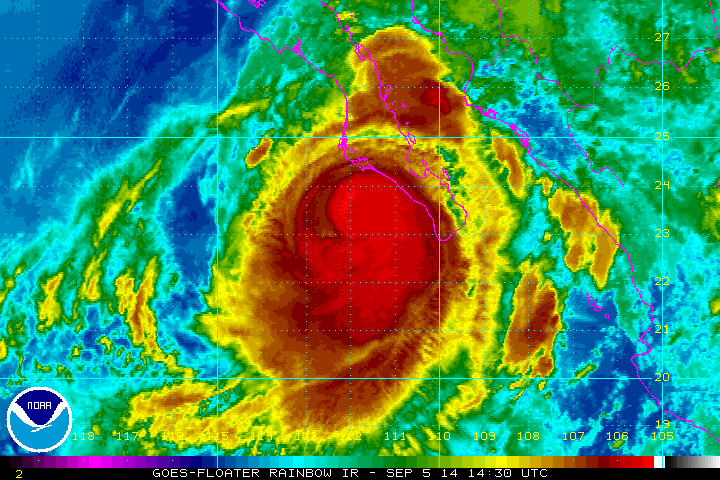
Hurricane Odile - Cat 4

Hurricane Odile – Cat 4

“Odile” is the latest in a string of late-season hurricanes with similar paths – off the west coast of Baja. But each one seems to have been moving slightly closer to land – and Odile looks as he he’ll skim the coastline, wreaking havoc with winds and rain. On Sunday morning, the storm has already intensified to a Category 4 – a “major and dangerous hurricane” – with sustained winds at 135mph and gusts up to 160mph. Batten the hatches. Put up the storm shutters and bring all the patio furniture inside.

Even in their fury, the storms seen from satellite are mesmerizing.

After the storm ….

Sultry .. the air thick with moisture but still. No wind ruffles the palm fronds. Splashing fish jar the glassy sea surface and small shorebirds call to one another in their morning search for food. Golden sun drives trails across the water, free from her stormy yesterdays. A low bank of clouds hangs over Isla Carmen’s craggy shape. At the water’s edge, tiny rolling bumps curl and roll into sand and stone. The passing of the storm .. the beginning of a new day.

Sunday dawn .. after the storm

Sunday dawn .. after the storm

Hurricane Norbert – September, 2014

I admit it .. I’m a storm junkie. Something about the drop in barometric pressure and the wildness in the skies. I became edgy. Can’t sit still or focus. Pace the perimeter. Waiting. Watching the sky. Watching satellite photos and charts. Norbert was to be small .. A category 1 storm for a short time and then a tropical depression. He fooled us all by building to a Category 3 – but all of it off the west coast of Baja – and with no serious impact.  We had 3″ of rain in Loreto and an amazing 49mph gust.  I was awakened at 3am by what sounded like a bucket of water thrown at the window.  Palm fronds bent agains the weight of the wind.  The normally placid Sea of Cortez whipped to a wind-chopped frenzy.  A wild alertness that accompanies a storm.  Yes, a junkie – particularly when they have some punch but no destruction.

rb0-lalo
The storm sent clouds north from south and west of Cabo San Lucas on the afternoon of the 4th. By dawn (okay it was dark with no real sunrise) the storm had moved up the peninsula and after the 3am slam, rain and winds began to affect Loreto. By 3pm, the skies had opened, the wind had laid low the palm trees and ‘game on’ – the storm raged through and into the dark of night. Morning, the 6th, still dark skies, but by afternoon – clearing skies. Then sunset, an arm of the storm – now directly west of Loreto – laid a thick band of grey which intermittently spit water. Seas calm. Storm now a memory. We wait for the next circular disturbance.

Thoughts from Mark Spalding & The Ocean Foundation

World Oceans Day: A Chance to Remember Complex Connections

By Mark J. Spalding, President, The Ocean Foundation

In advance of my most recent trip to Mexico, I had the good fortune to participate with other ocean-minded colleagues, including TOF Board member Samantha Campbell, in an “Ocean Big Think” solutions brainstorming workshop at the X-Prize Foundation in Los Angeles.  Many good things happened that day but one of them was the encouragement by our facilitators to focus on those solutions that touch the most ocean threats, rather than address a single problem.

This is an interesting frame because it helps everyone think about the interconnectedness of different elements in our world—air, water, land, and communities of people, animals, and plants—and how we can best help them all be healthy.  And when one is thinking about how to address the big threats to the ocean, it helps to bring it down to the community level—and thinking about ocean values being replicated over and over gain in our coastal communities, and good ways to promote multi-pronged solutions.

Ten years ago, The Ocean Foundation was founded to create a global community for ocean conservation minded people.  Over time, we have had the good fortune to build a community of advisors, donors, project managers, and other friends who care about the ocean everywhere.  And there have been dozens of different kinds of approaches to improving the human relationship with the ocean so that it can continue to provide the air we breathe

Vet in Loreto

I went from that Los Angeles meeting down to Loreto, the oldest Spanish settlement in Baja California.  As I revisited some of the projects we funded directly and through our Loreto Bay Foundation, I was reminded of just how diverse those approaches can be—and how it is hard to anticipate what might be needed in a community.  One program that continues to thrive is the clinic that provides neutering (and other health) services for cats and dogs—reducing the number of strays (and thus disease, negative interactions, etc.), and in turn, the runoff of waste to the sea, predation on birds and other small animals, and other effects of overpopulation.

Mangroves Planted by TOF

Another project repaired one shade structure and added an additional smaller structure for a school so that children could play outside at any time.  And, as part of our effort to make already permitted development more sustainable, I was pleased to see that the mangroves we helped plant remain in place in Nopolo, south of the old historic town.

Yard Sale at EcoAllianza

Still another project helped Eco-Alianza on whose advisory Board I am proud to sit.  Eco-Alianza is an organization that focuses on the health of Loreto Bay and the beautiful national marine park that lies within. Its activities—even the yard sale that was happening the morning I arrived to visit—are all part of connecting the communities of Loreto Bay to the incredible natural resources on which it depends, and which so delight the fishermen, tourists, and other visitors.  In a former house, they have built a simple but well-designed facility where they conduct classes for 8-12 year olds, test water samples, host evening programs, and convene local leadership.

Loreto is just one small fishing community in the Gulf of California, just one body of water in our global ocean.  But as global as it is, World Oceans Day is as much about these small efforts to improve coastal communities, to educate about the rich diversity of life in the adjacent marine waters and the need to manage it well, and to connect the health of the community to the health of the oceans.  Here at The Ocean Foundation, we are ready for you to tell us what you would like to do for the oceans.

IMGP0011

Always Dreaming …

Even when I’m not in Baja, I dream of her. The starkness and beauty of her deserts. The rugged cliffs of her mountain ranges. The two faces of her seas – the Pacific Ocean and the Sea of Cortez. Blessed with a 2 hour reach of either side, I can trade surfboard for SUP board – cold fish for warm fish – crashing waves for serene waters.

Last evening, I paddled the Sea of Cortez and was rewarded with leaping fish and soaring birds. Here’s a small sampling:

SUP to “Tern Island”

Lured by their incessant chatter, I followed the tern-song south on my SUP to find “Tern Island.” Congregated on a sand spit created by the last storm at the mouth of the river and estuary, they gathered in a ‘clump’ all to themselves – surrounded by cormorants, pelicans and blue-footed boobies. A virtual chatter feast of avian calling filled the morning air as all beaks raised to join the chorus. Enchanting, really …. and worth the extra miles of paddle.

Arctic Terns in Loreto, BCS, MX

Arctic Terns

Blue-footed Boobies

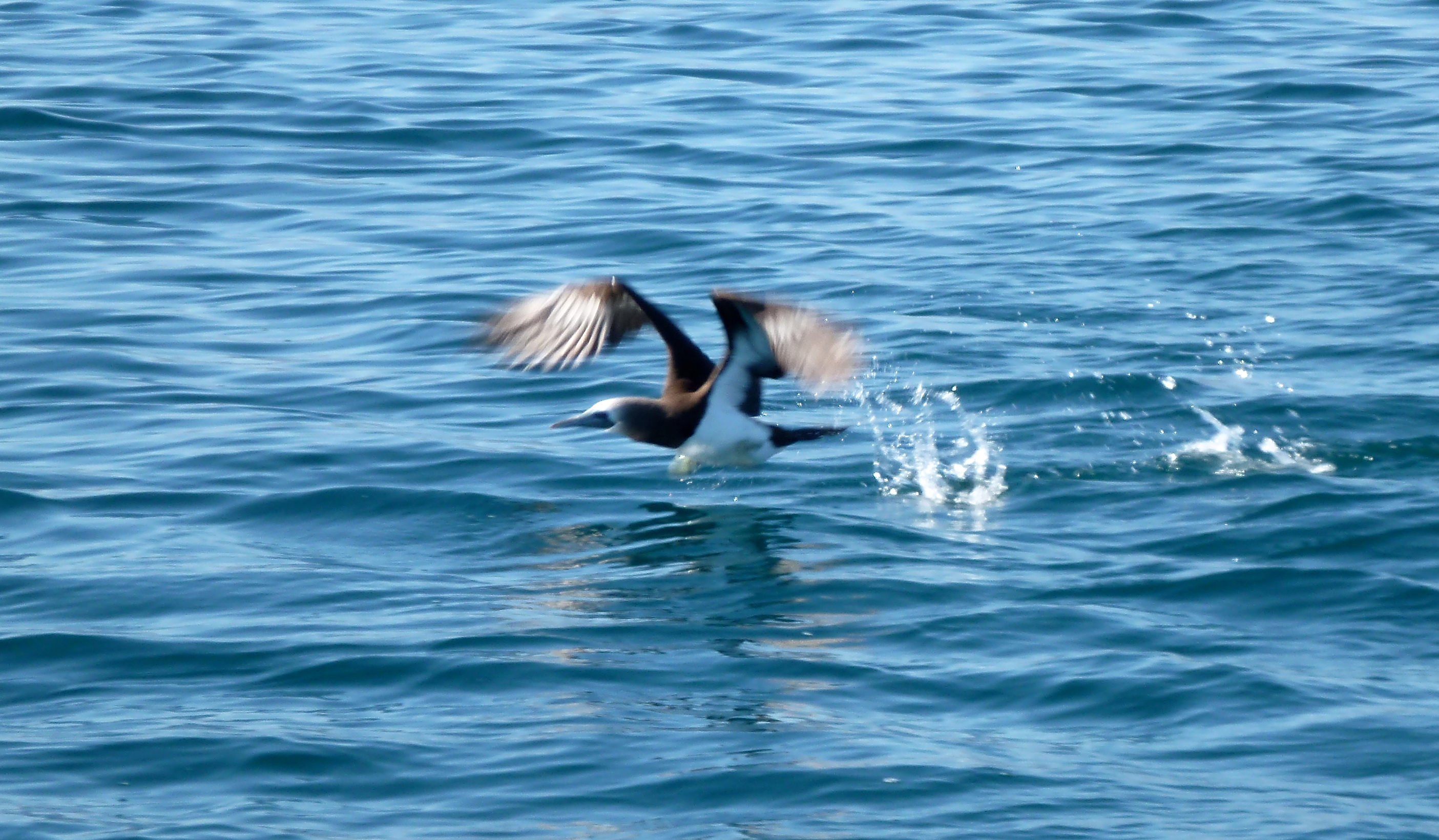
Blue-footed Boobie Taking Flight

Blue-footed Boobie Taking Flight


Early morning SUP. The sun fresh from its rise behind Isla Carmen and the sea momentarily in stillness. The blue-footed boobies make the rounds of the shallows: soaring, gliding, spying, diving for tiny bait fish. I love to watch them speed toward the water, almost like a fighter jet, wings pulled in tight for a dive below the surface. Sometimes they actually swim underwater, only to pop up with tiny fish in their beaks. They fly low to the water after take-off, using ground effect to give them time to dry their wings before they are air-born again. The morning show goes on. The blue-footed breakfast bunch.
Blue-footed Boobie Hunting

Blue-footed Boobie Hunting